Trending
 Sakunth
 6 min read
June 29, 2026 | 9:55 AM
Planning to pursue AI after 12th? Learn about the different AI courses, eligibility requirements, duration, fees, admission process, and career paths to choose the right program for your goals.
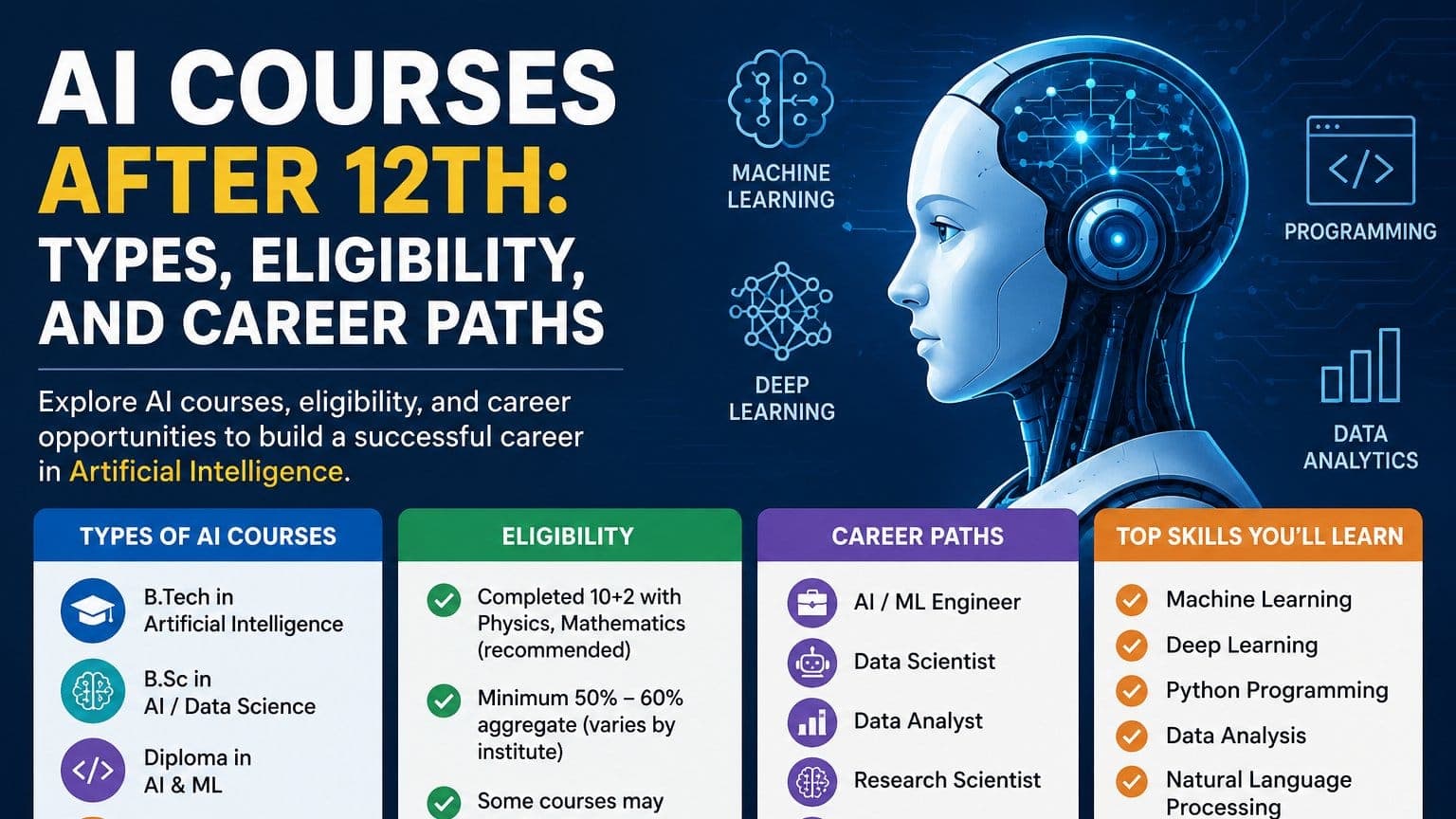
AI is the future, and there is no denying that it might be required as a mandatory skill for future jobs. Choosing to pursue AI courses after 12th may serve you a bigger purpose than you anticipate. Numerous big institutes are now offering UG courses focused on AI and even Diploma and Certificate programs that you can pursue along with your main degree to get a key understanding of AI and its modules. According to reports, India will see an AI boom in the future, with the demand for AI professionals increasing year on year. It is highly favourable if you enter the field early on.
Discover some AI Courses After 12th below:
From degree courses to specialisations and diplomas, there are a bunch of courses that you can pursue to enhance your knowledge of AI and its modules. Explore some options that you can pursue after 12th below:
Eligibility for a course depends on the course that you decide to pursue. For example, engineering courses usually have a high cut-off mark, and you also need to appear for an entrance exam. Refer to the eligibility criteria for the courses discussed above:
| Course Type | Minimum Marks Required (12th) | Stream / Subject Requirements | Common Entrance Exams |
| B.Tech (AI & ML / CSE-AI) | 60% to 75% Aggregate | Science Stream with Physics, Chemistry, & Math (PCM) | JEE Main, JEE Advanced, BITSAT, VITEEE, MHT-CET |
| B.Sc. in AI / Data Science | 50% to 55% Aggregate | Science Stream preferred (Some colleges accept Computer Science/Math from other streams) | CUET UG, University-specific tests |
| BCA with AI Specialization | 50% Aggregate | Open to All Streams (Science, Commerce, Arts). Math/IP in 12th is a plus, but not always mandatory. | CUET UG, IPU CET, or Direct Merit |
| Diploma / Certifications | 45% to 50% Aggregate | Open to All Streams (No specific subject restriction) | Usually Direct Admission / Portfolio-based |
When pursuing an in-depth professional AI course, you will learn a set of a special skills that you need to decode the AI module and use it to your advantage, such as:
After developing basic AI knowledge, doors open to various career opportunities pretty easily, with the fastest-growing roles in the global tech ecosystem, like:
When the internet is flooded with certification courses, and everywhere you look, there is a new AI course advertised, it is important to choose the right one to suit your goal and help you become AI fluent to support your career in the long run.
Here is how to choose the right AI course for your goals:
Before diving into any AI course or degree, you should ask yourself what you want to achieve in the next couple of years and what your ultimate goal is. If you want to focus on a heavy technical foundation, then you should go for long-term structured programs like a Bachelor's Degree in AI, which will help you to understand AI modules and teach you backend algorithms.
On the other hand, if your goal is to develop your skills and become job-ready, then you can look for courses in non-technical AI applications like digital marketing optimization, data visualization, or product workflows. You can also go for short-term certificate programs that make your resume look fancy and give you practical experience.
Short-term courses are specifically built for students who want to test the waters before committing to a massive course, which also leaves a financial strain on their pockets. Explore the different types of certification programs that you can consider to learn about AI:
| Certification Type | Best For | Time Investment |
| No-Code / Conceptual | Understanding what AI can do, basic prompt patterns, and data ethics. Perfect for absolute beginners or Commerce/Arts students. | Under 10 to 40 Hours |
| Vendor-Specific Cloud AI | Proving you know how to navigate pre-built AI cloud infrastructure. Highly valued by companies using specific tech stacks. | 1 to 2 Months |
| Applied Technical Tools | Learning how to write Python scripts, use OpenAI APIs, build vector databases, and deploy Retrieval-Augmented Generation (RAG) systems. | 3 to 6 Months |
When choosing an AI course, look for practical and hands-on training so that you can experiment with the theory taught in these courses. Make sure that you have your portfolio ready at the end of the course to attract recruiters and job opportunities.