Fine-Tuning Open-Source LLMs vs. Prompt Engineering: Which Skill Gets You Hired?
Rupsa Chakrabarti6 min read
August 4, 2026 | 6:13 PM
Prompt engineering is now a baseline skill. Hiring managers favor engineers who can fine-tune and host open-source LLMs like Llama 3 to build private, low-cost, and scalable enterprise AI solutions.
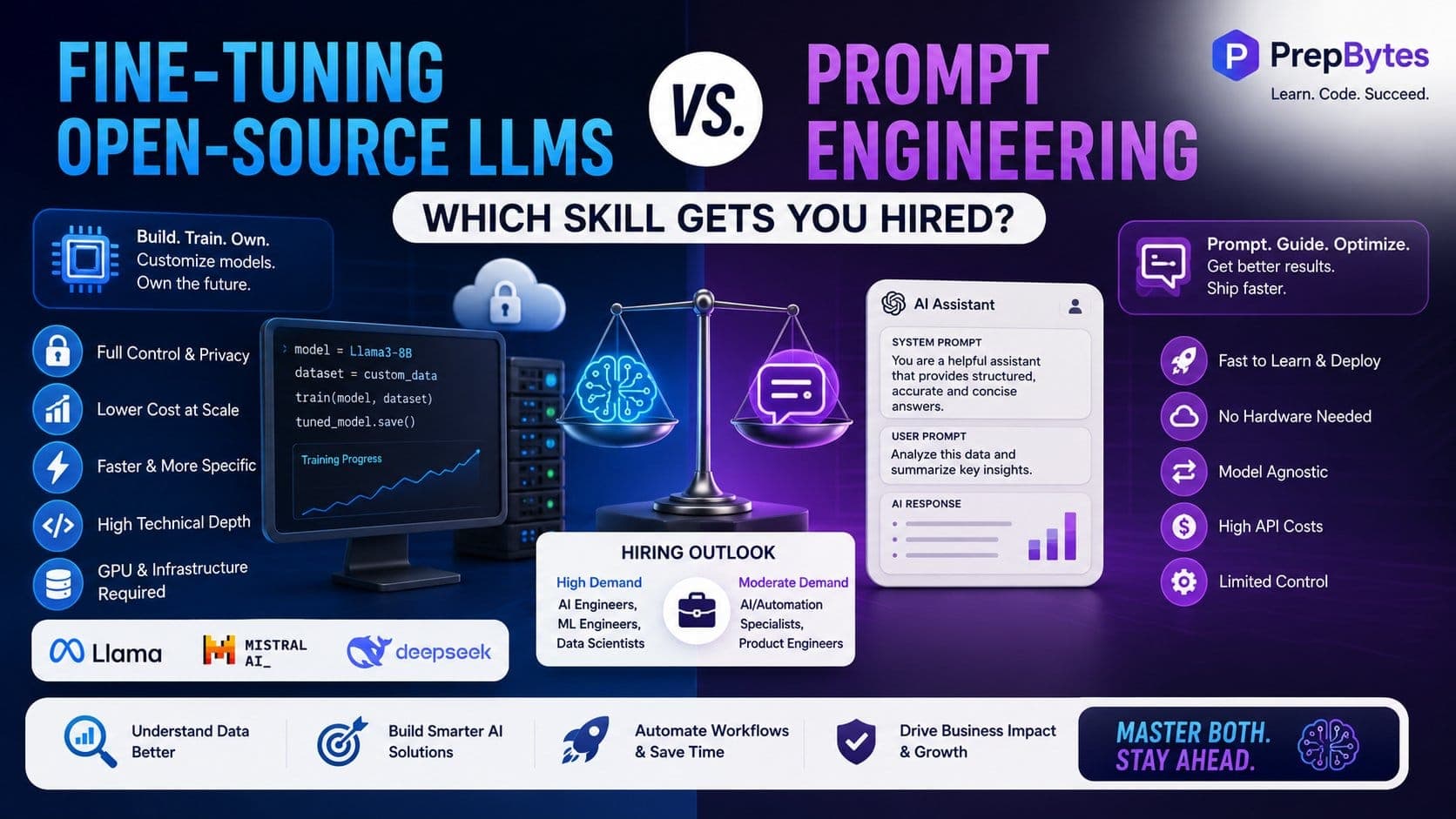
Prompt engineering as a skill saw a huge spike recently. However, AI is ever-evolving, so companies later realized that they need people who know more than just how to give prompts to AI. Simply knowing how to use AI chatbots is not enough. In 2026, recruiters are looking for people who are comfortable using AI to build automated workflows and develop ready-to-launch software. As open-source Artificial Intelligence models like Meta’s Llama, Mistral, and DeepSeek become more powerful, tech leaders face a major choice: Should they hire specialists who know how to fine-tune open-source models, or engineers who excel at prompt engineering?
If you are looking to build a career in AI, Fine-Tuning Open-Source LLMs vs. Prompt Engineering is a common doubt. Let’s address it in detail:
Understanding Prompt Engineering: Low Barrier, High Accessibility
Prompt Engineering is learning how to talk to AI chatbots to drive out a refined output. Modern prompt engineering is much more than how to write good prompts:
System Prompts: Writing detailed instructions that define the model's persona, rules, boundaries, and expected output format.
In-Context Learning (Few-Shot Prompting): Giving the model a few examples of input-output pairs inside the prompt so it understands what a correct answer looks like.
Chain-of-Thought Prompting: Instructing the model to break down complex logic step-by-step before arriving at a final answer.
Retrieval-Augmented Generation (RAG): Feeding external document data directly into the model's context window alongside the prompt so it can answer questions using proprietary or updated information.
The Key Benefits
Fast to Learn and Deploy: You don't need a degree in Data Science to start. You can test ideas in minutes using standard Web interfaces or simple API calls.
No Hardware Costs: You rely entirely on servers hosted by companies like OpenAI, Anthropic, or Google. You do not need expensive GPUs (Graphics Processing Units).
Model Agnostic: A good prompt strategy can often be adapted easily across different frontier models with minor tweaks.
The Drawbacks
High Variable Cost: Every time a user sends a large prompt with context, you pay the API provider based on token count. At a massive scale, this becomes extremely expensive.
Lack of Full Control: You cannot change the underlying logic or weights of the model. If the provider updates the model background version, your prompts might unexpectedly break or behave differently.
Context Window Limits: Even with large context windows, stuffing too much text into a prompt can lead to forgotten details or increased processing latency.
Understanding LLM Fine-Tuning: Deep Expertise and High Engineering Overhead
While prompt engineering works on the outside of a pre-trained model, Fine-Tuning alters the internal brain of an open-source model.
Fine-tuning is the process of taking a base model (such as Llama 3 or Mistral) that has already learned general human language, and training it further on a smaller, highly specialized dataset. Instead of telling the model how to act every single time via a long prompt, you adjust its actual parameters (weights) so that its default behavior aligns with your exact needs.
Modern fine-tuning involves techniques like:
PEFT (Parameter-Efficient Fine-Tuning): Techniques like LoRA (Low-Rank Adaptation) and QLoRA that allow engineers to fine-tune massive models using a fraction of the compute power by updating only a small subset of parameters.
Dataset Curation: Cleaning, formatting, and preparing thousands of high-quality examples to teach the model a specific style, language, or JSON response format.
Quantization: Reducing the precision of model weights (converting them from 16-bit to 4-bit or 8-bit) so they can run smoothly on lower-cost GPUs.
Model Evaluation: Running standard performance benchmarks to ensure the fine-tuned model didn't lose its basic reasoning abilities (a problem known as "catastrophic forgetting").
The Key Benefits
Complete Control & Privacy: You download the open-source weights and host the model on your own servers or private cloud. Sensitive business or customer data never leaves your infrastructure.
Lower Long-Term Cost at Scale: While training costs upfront, running your own smaller fine-tuned model for millions of requests is often significantly cheaper than paying third-party API fees per token.
Speed and Specificity: A smaller, fine-tuned model can generate structured outputs faster and more consistently than a massive commercial model that requires a huge prompt to behave correctly.
The Drawbacks
High Technical Barrier: Requires strong knowledge of Python, PyTorch, machine learning theory, GPU infrastructure, and data handling.
Upfront Expense: Renting cloud GPUs for training, experiment tracking, and hosting model endpoints requires a dedicated hardware budget.
Fine-Tuning Open-Source LLMs vs. Prompt Engineering
Let's look at some basic differences between Fine-Tuning Open-Source LLMs vs. Prompt Engineering:
Feature / Criteria
Prompt Engineering / RAG
Open-Source Fine-Tuning
Primary Skill Requirement
System logic, clear communication, API integration, RAG pipelines
Python, PyTorch, Linear Algebra, GPU infrastructure, ML pipelines
Primary Goal
Directing model output without changing model weights
Modifying internal model weights for custom task performance
Initial Cost
Very Low (pay per API call)
Moderate to High (requires GPU resources for training)
Deployment Complexity
Easy (software API integration)
Complex (requires hosting, serving frameworks, model monitoring)
Data Privacy Level
Medium (data sent to third-party APIs unless enterprise plan used)
Maximum (everything runs inside self-hosted/private cloud environment)
Job Market Competition
High supply of entry-level candidates
High demand for skilled technical candidates
The Industry Verdict: Which Skill Sets Are Hiring Managers Actually Looking For?
Prompt Engineering jobs have seen a significant decrease in the last few months. Recruiters are looking for people who know more than just how to write good prompts. RAG development has simply become baseline skills expected of standard Software Engineers, Product Managers, and Full-Stack Developers.
On the other hand, demand for Machine Learning Engineers, AI Engineers, and Data Scientists who can fine-tune and host open-source models is at an all-time high. Here is why hiring managers favor fine-tuning capabilities:
AI Autonomy and Cost Control: Enterprises want to own their technology stack. Relying 100% on external APIs leaves businesses vulnerable to price changes, API outages, and privacy risks. Engineers who can bring open-source models in-house save companies millions of dollars at scale.
Technical Depth Is Harder to Replace: Basic prompt writing can be learned in a weekend or automated by the AI models themselves. Fine-tuning requires an understanding of data hygiene, memory management, CUDA drivers, and evaluation frameworks—skills that take months or years of practice to master.
The Rise of Hybrid Architecture: Real-world enterprise products rarely choose only one method. The most effective AI products use a fine-tuned open-source base model combined with structured prompts and RAG pipelines. Hiring managers look for engineers who understand both sides of this coin.
How to Future-Proof Your AI Career
When you approach AI modules with the right strategy, you can integrate them smoothly into your career:
Master the Fundamentals of Prompting & RAG First: Learn how to connect APIs, build Retrieval-Augmented Generation (RAG) pipelines using vector databases, and structure outputs reliably. This gives you quick wins and builds product context.
Learn Python and Machine Learning Frameworks: Gain working knowledge of Python libraries like PyTorch, Hugging Face Transformers, datasets, and peft.
Build Hands-on Fine-Tuning Projects: Download a small open-source model (like Llama 3 8B or Mistral 7B), curate a custom dataset on a specific domain (like legal documents or code conversion), fine-tune it using QLoRA on a platform like Google Colab or RunPod, and evaluate its output against a base model.
Showcase Your Portfolio: Highlight your ability to optimize model latency, reduce costs, and maintain data privacy.
Prompt engineering is a great start to understanding AI modules; however, if you want to go into more technical depth, you need to develop skills such as open-source fine-tuning and model customization.
BEGINNER30 DAYS6 HRS / WEEK
AI for Campus
AI for Campus — Your AI Edge in College & Beyond. Powered by Claude by Anthropic · 30 Days · All Streams Welcome. A first-of-its-kind AI literacy programme for students entering graduation and post-graduation. This is not a theoretical course — every session puts Claude...
BEGINNER TO INTERMEDIATE3 MONTHS2 HRS / WEEK₹1,501 OFF
Claude AI for Shopify
This bootcamp is for D2C founders, e-commerce entrepreneurs, and students targeting retail tech careers. Build and grow a Shopify store end-to-end using Claude as your content engine, ops assistant, and analytics co-pilot. Go beyond basic tutorials — integrate AI into r...
BEGINNER TO INTERMEDIATE3 MONTHS2 HRS / WEEK₹1,501 OFF
Claude AI for Business Analytics
This bootcamp trains analysts, finance pros, ops managers, and consultants to turn data into decisions using Claude as an AI co-pilot. Participants learn to clean data, write SQL, build dashboards, interpret KPIs, and deliver executive insights — no data science degree ...
BEGINNER TO INTERMEDIATE3 MONTHS2 HRS / WEEK₹1,501 OFF
Claude AI for Content Creators
This bootcamp is built for content creators, copywriters, social media leads, and aspiring writers who want to use AI as a creative co-pilot — not a ghostwriter. In a world where content is the currency of influence, this programme ensures you produce more, faster, with...
BEGINNER TO INTERMEDIATE3 MONTHS2 HRS / WEEK₹1,501 OFF
Claude AI for Digital Marketing
This bootcamp is built for aspiring marketers, growth hackers, and performance specialists. In a world where content velocity wins, this programme ensures you enter the industry with a real competitive advantage — the ability to plan, create, and optimise full marketing...
BEGINNER TO INTERMEDIATE3 MONTHS2 HRS / WEEK₹1,501 OFF
Claude AI for Vibe Coding
This bootcamp is built for non-coders, first-time builders, and anyone who has ever had an idea for a product but couldn't code it. Using natural language and Claude's AI capabilities, you will ship real apps, websites, and automations — without memorising syntax or sit...
 Trending
 Rupsa Chakrabarti
 6 min read