Trending
 Rupsa Chakrabarti
 6 min read
July 30, 2026 | 5:20 PM
AI literacy is now essential for non-tech roles. Marketers and product managers use AI to analyze data, draft PRDs, and automate workflows—spending 80% of their time on strategy over execution.
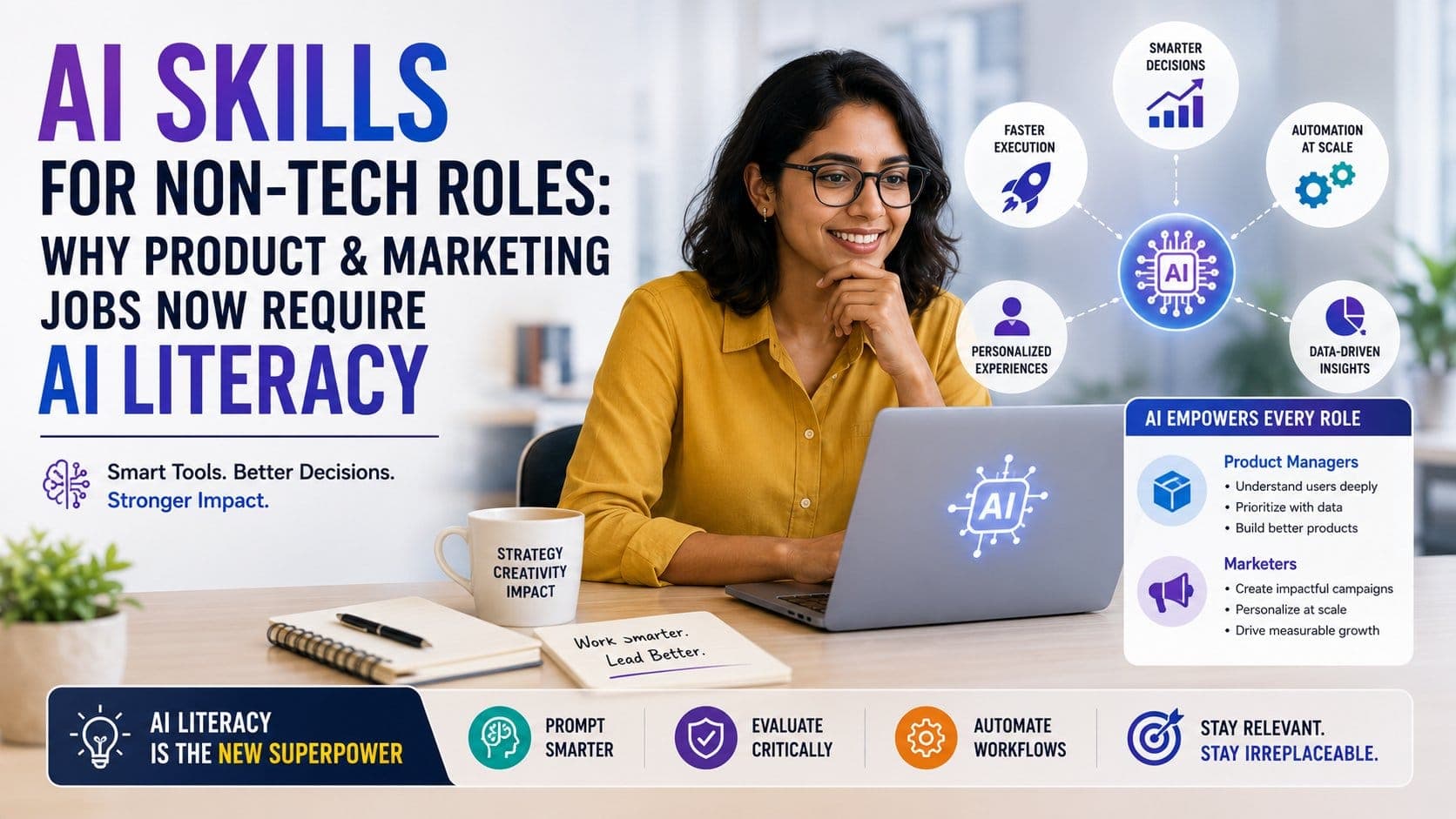
Traditionally, AI was only for engineers and software developers who knew how to code, but now managers and marketers are the one who needs it the most. You no longer need a computer science degree to understand the dynamics of AI. With the help of generative AI, marketers can come up with campaign ideas that are highly customized for each set of consumers. AI literacy is no longer an additional skill but the most needed skill in 2026 to be at the top of the game.
Learn about the most-needed AI skills for non-tech roles below:
In 2026, marketing professionals can interact with sophisticated technical features like data models, software generators, and automation engines simply by writing a clear prompt. Traditionally, non-technical teams were always behind technical teams and worked as consumers of software built by engineers and developers.
Now, you don't need to know how standard deviation is calculated under the hood to ask an AI tool to run a statistical analysis on campaign performance.
This shift has created a clear divide in the workforce:
The baseline expectation for hiring has shifted accordingly. Employers are no longer asking, "Do you know how to use an AI tool?" They are asking, "How do you integrate AI into your daily workflow to deliver results three times faster?"
Product Managers (PMs) spend an enormous amount of time on coordination and documentation: drafting Product Requirement Documents (PRDs), writing user stories, triaging feature requests, and synthesizing user research.
AI literacy transforms a PM from a bogged-down documentation manager into a high-leverage strategic orchestrator.
With the help of AI, you can feed raw data and get visually appealing, useful information in just a matter of a few seconds, which can help immensely to collect user feedback. This will help you to quickly identify customer friction points; you can also use AI to categorize the feedback. This eliminates the need to spend days reading through hundreds of customer survey responses.
Drafting a PRD from scratch is time-consuming. AI allows PMs to generate comprehensive baseline PRDs—complete with user flows, success metrics, and edge cases—in minutes. The PM's role shifts from writing blank-page drafts to editing, refining, and validating the strategic direction.
Using AI-powered design and no-code tools, PMs can move from an abstract concept to a clickable prototype in an afternoon. This allows teams to validate assumptions directly with users before handing specifications off to engineering teams, drastically saving expensive developer hours.
Marketing is a time-consuming vertical of any company, but with the help of AI, managers can now scale quickly; they do not need to write highly personalized messages by hand for different customers. All manual tasks can be automated with AI Tools.
With the help of AI, you can make highly customized marketing campaigns for each customer without running out of ideas.
With the help of AI, modern marketers can now build personalized brand voices without having to customize each post. They feed AI precise customer persona profiles, brand voice guides, and value propositions.
Data-driven marketing used to require SQL knowledge or a dedicated analytics partner. Today, AI-literate marketers upload raw campaign CSVs directly into AI tools to ask questions like: "Which ad set had the lowest customer acquisition cost relative to customer lifetime value, and what headline angles did those ads share?"
Instead of spending two weeks waiting for initial ad variations, marketers can brainstorm dozens of creative angles, visual concepts, and hook options in a single brainstorming session. They can test 20 micro-variations of a campaign simultaneously, let the data decide the winner, and double down on performance in real time.
Notice that none of the applications above require writing a line of code. AI literacy for non-technical roles isn't technical skill—it is cognitive skill.
To thrive, product and marketing professionals need to master three core competencies:
You cannot give a single sentence to AI and expect it to deliver results that meet your standards; your context must be detailed and rich. High-performing marketers need a basic prompt engineering course to understand how to use AI to their advantage.
AI models have a habit of hallucinating, and they are oddly confident even when delivering wrong facts, so you need to develop skills to catch lies quickly. AI literacy means developing a sharp operational instinct for catching hallucinations, subtle logical errors, and brand alignment issues.
Knowing how to talk to ChatGPT or Claude is step one. Step two is connecting those models into your existing software stack using tools like Zapier, Make, or built-in workspace automations. An AI-literate professional builds simple systems where routine inputs (like a submitted customer feedback form) automatically trigger AI analysis and output directly into Slack or Jira.
The AI landscape moves at a staggering pace, making it easy to feel overwhelmed by new tools launching every day. You don't need to try every tool; you just need to build a consistent habit.
AI cannot replace humans; however, if marketers and managers who do not have AI knowledge continue with tedious manual labour, then they will be replaced by managers and marketers who are AI fluent very quickly. To build hands-on AI literacy and lead strategic projects with confidence, check out the PrepBytes Claude AI Literacy Course that is designed to help non-tech professionals master modern AI tools and stay ahead in the job market.