Trending
 Sakunth
 4 min read
July 1, 2026 | 5:41 PM
Python still rules AI, but basic coding isn't enough. Recruiters want engineers who can build secure data pipelines, manage async workloads, and deploy containerized apps that never crash.
The rules for getting a tech job after graduation have changed completely. Companies are no longer paying for raw syntax; knowing how to type out a Python code is the minimum requirement—a chatbot can write the code in a few seconds. Recruiters want graduates who know how to take that code, run it safely and quickly, and make sure it doesn’t crash the systems when millions of people start using it at the same time.
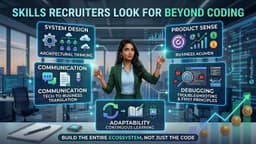
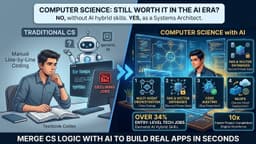
To excel in the current job market, you need to transform yourself from being a "code writer" to a "system architect." Since AI models can now generate basic syntax instantly, your value lies in knowing how to build, optimize, and secure the infrastructure around the model.
Here are some essential Python skills for AI beyond basic syntax that you must learn:
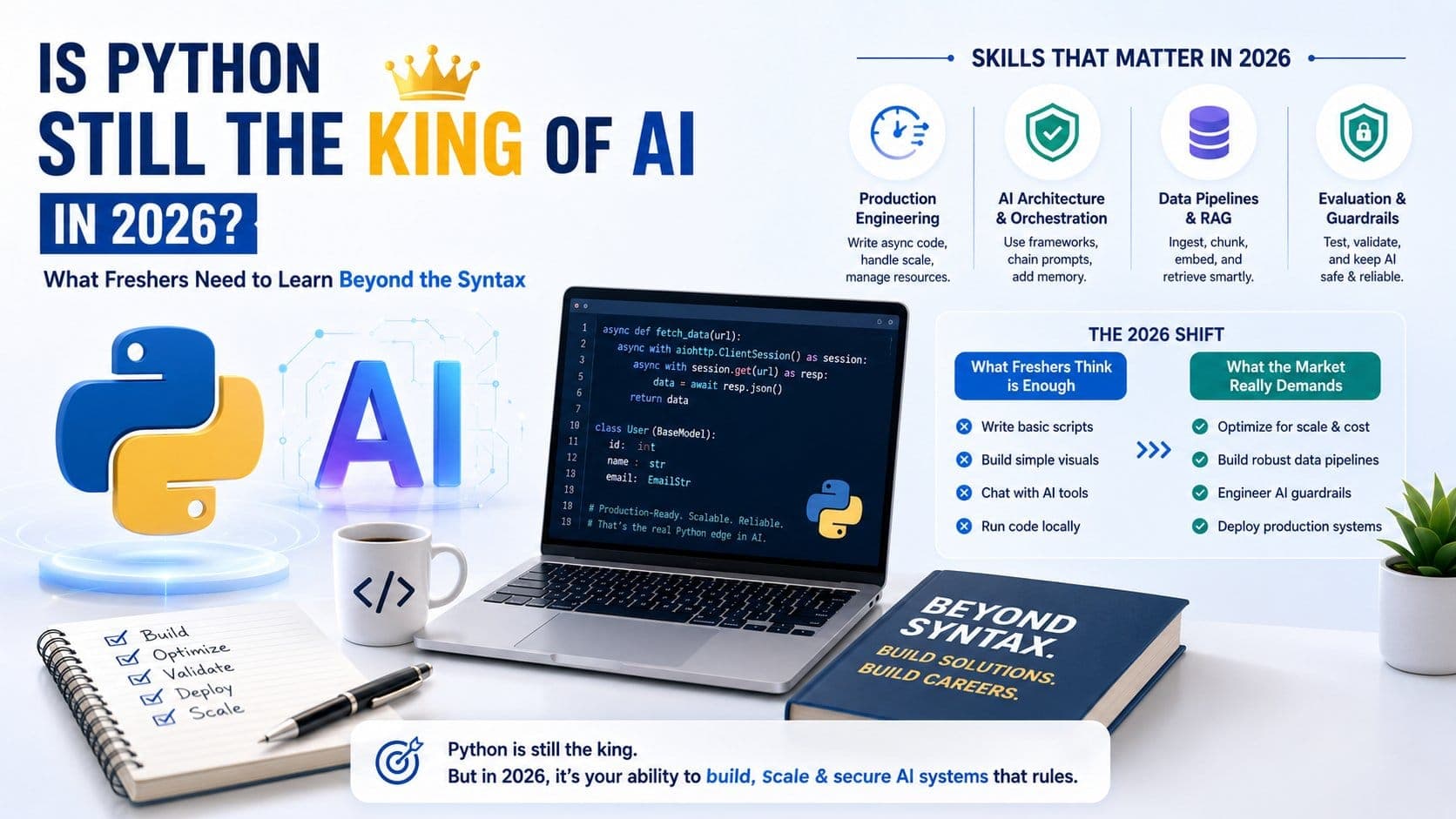
| Category | Essential Skill | Why It Matters | Practical Implementation |
| 1. Production-Grade Engineering | Asynchronous Programming (asyncio) | AI APIs take time to respond. Synchronous code freezes the entire application while waiting for the model. | Use async/await paradigms to handle thousands of concurrent user requests without bottlenecking. |
| Data Validation (Pydantic) | LLM outputs are chaotic and unpredictable, but software backends require strict data shapes. | Build rigid data schemas to force raw AI text into type-safe Python objects that won't crash your app. | |
| Dependency Management (Poetry / Docker) | AI packages and libraries change, conflict, and deprecate on a weekly basis. | Containerize your Python runtimes so your codebase runs identically on your laptop and a cloud server. | |
| 2. AI Architecture & Orchestration | Orchestration Frameworks (LangChain / LlamaIndex) | Production apps rarely use raw, isolated models; they need structure and memory. | Program logical pipelines that give models context, save session memories, and chain prompts together. |
| Vector Database Integration | Traditional SQL databases aren't built to handle semantic AI search or embeddings. | Use Python SDKs to connect to databases like Pinecone or Chroma to store and query mathematical data vectors. | |
| 3. Data Pipelines & RAG | Advanced Data Ingestion | Real-world corporate data doesn't live in clean, pre-formatted CSV files. | Write Python scripts to scrape messy PDFs, Word docs, and SQL databases, then cleanly chunk the text for the LLM. |
| RAG Pipeline Construction | Companies don't train massive models from scratch; they feed their private data to existing ones. | Build the end-to-end Python codebase that bridges your secure internal database directly to the AI engine. | |
| 4. Evaluation & Guardrails | Defensive Guardrails | AI models will hallucinate, go off-topic, or accidentally leak sensitive user data if left unchecked. | Program automated safety nets (using tools like Guardrails AI) to catch and block bad model behavior instantly. |
| Automated Evaluation (Evals) | When an AI application breaks, it doesn't throw a syntax error—it just confidently lies. | Write Python evaluation scripts to statistically stress-test your system's accuracy over thousands of simulated runs. |
To turn basic Python knowledge into a secure, lucrative career that AI can’t replace, master the professional tools used to build real software.
The PrepBytes Claude AI for Campus program powered by CollegeDekho moves beyond standard programming you already learned in college. The program bridges the gap between simple code writing and working like a real developer. It teaches you the exact hands-on skills needed to build stable, real-world AI applications that companies actually want to buy.
Here’s a quick glance at what an average student brings to the table and what companies are actually looking for in 2026:
| What Freshers Think is Enough | What the 2026 Market Demands |
| Writing a clean import numpy script | Optimizing code loops to minimize API token costs |
| Building basic data visualizations | Engineering automated, production data pipelines |
| Knowing how to chat with an AI web UI | Programming strict system guardrails via APIs |
| Running code locally in a Jupyter Notebook | Deploying containerized Python applications |
Python is still the king of AI, but to build a secure career, you need to upgrade your Python skills with AI to focus on system orchestration, data pipelines, and production-grade architecture. The true value of an engineering degree now lies in mastering tools like async programming, vector databases, and validation guardrails that keep apps from crashing. So, stop using AI like a chat box and start building the scalable infrastructure companies are actually desperate to buy.