Trending
 Rupsa Chakrabarti
 6 min read
August 5, 2026 | 6:06 PM
Claude hallucinates due to next-token prediction and context dilution. Developers can stop AI hallucinations by using XML-enclosed grounding, quote-first citations, and strict JSON schemas.
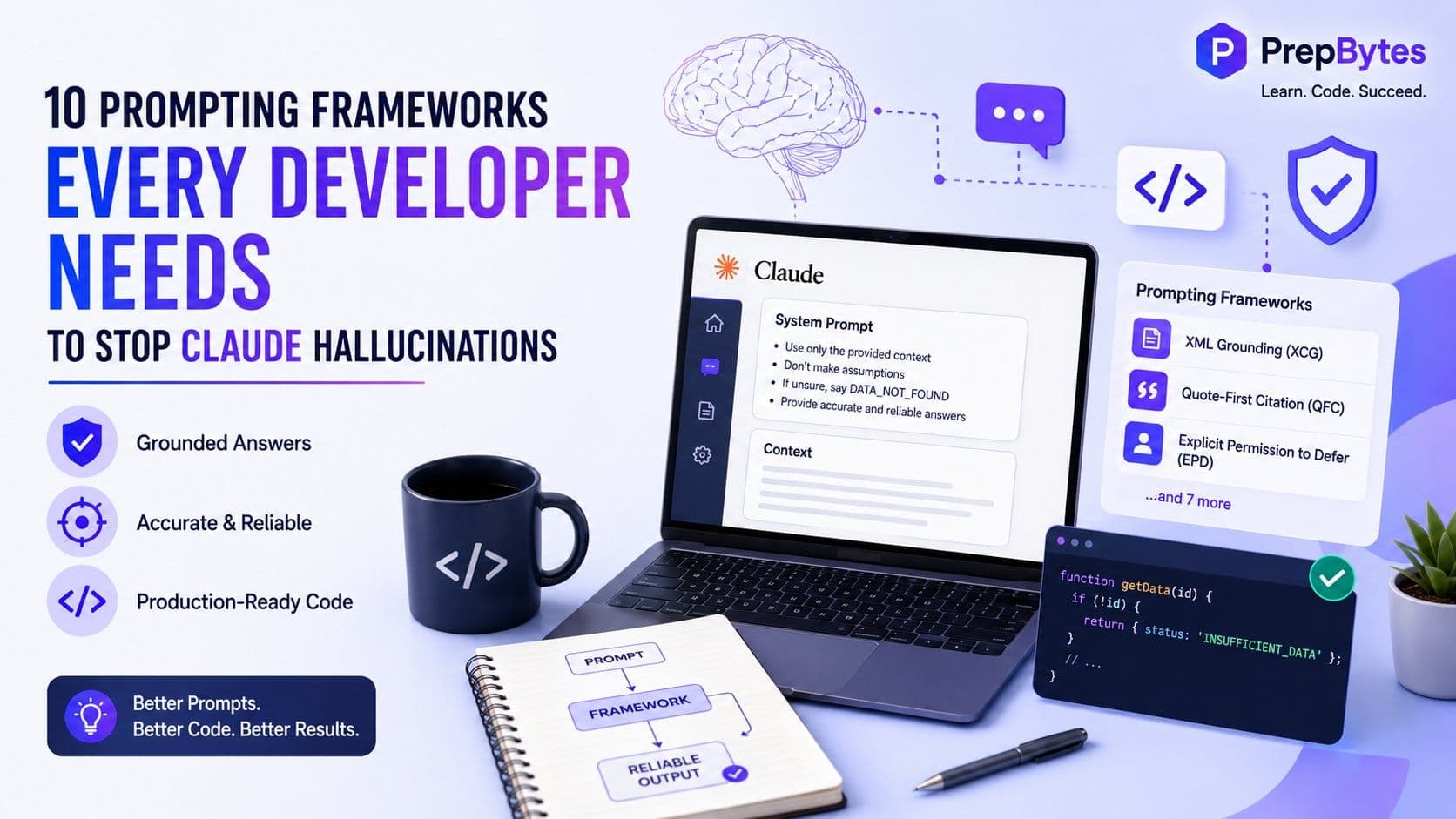
Anthropic's Claude models are among the most capable LLMs on the market. However, like all large language models, Claude can still hallucinate, confidently outputting false information, non-existent code libraries, or incorrect citations.
When building production software, hallucinations aren't just minor typos; they are system bugs. This guide breaks down 10 battle-tested prompting frameworks developers can use to eliminate hallucinations and build reliable, production-grade applications with Claude.
Claude hallucinates primarily because of how it processes language:
To fix this, developers must use structured prompt architectures that force Claude to anchor its answers strictly to verified context.
Claude is uniquely optimized to recognize and parse XML tags. Placing system instructions, rules, and source data into separate XML tags prevents context bleed and prompt injection.
XML
<context>
[Insert your documentation, API spec, or reference text here]
</context>
<rules>
1. Answer the question using ONLY the facts listed inside the <context> tags.
2. If the answer cannot be found in the context, respond with "DATA_NOT_FOUND".
3. Do not use outside knowledge or make assumptions.
</rules>
<question>
[Insert user query here]
</question>
It creates clear boundaries. Claude treats content inside <context> strictly as raw input rather than executable system commands.
When asked to summarize or answer questions based on a document, LLMs tend to paraphrase and add unverified details. Forcing Claude to extract exact quotes before generating an answer grounds its output.
Plaintext
Read the provided document and complete the task using this exact process:
1. Create a <quotes> block and list verbatim quotes from the text that directly relate to the user's question.
2. Create an <answer> block. Draft your answer relying ONLY on the exact quotes listed above.
3. If you cannot find a relevant quote, state: "No direct quote available."
By writing the verbatim quote first, the correct information is placed directly into Claude's short-term context buffer right before it drafts the final answer.
Because Claude defaults to being helpful, it will often manufacture answers to obscure questions. Give the model explicit permission—and a specific code—to admit when it lacks sufficient information.
Plaintext
You are an API technical support bot. Answer the following question based on our documentation.
CRITICAL INSTRUCTION: If the documentation does not contain enough detail to answer the question with 100% certainty, DO NOT attempt to answer. Instead, output the following JSON response:
{
"status": "INSUFFICIENT_DATA",
"missing_field": "[Name of the topic or parameter missing]"
}
Removing the penalty for "not knowing" turns a potential hallucination into a predictable, handleable API error state.
Forcing Claude to perform step-by-step validation inside hidden reasoning tags before outputting a final answer drastically cuts logic errors and factual mistakes.
XML
Analyze the following code snippet for security vulnerabilities.
Before providing your final analysis, complete a verification check inside <thinking> tags:
<thinking>
1. List each function call in the code.
2. For each function, check against known vulnerability rules.
3. Double-check if the vulnerability is a true positive or false positive.
</thinking>
Output your final assessment inside <final_report> tags.
Next-token prediction improves significantly when the model produces intermediate reasoning tokens before committing to a definitive answer.
Unclear prompts invite assumptions, and assumptions lead to hallucinations. The CO-STAR framework ensures all necessary operational context is supplied up front.
Plaintext
- Context: We are migrating a legacy Node.js application to TypeScript.
- Objective: Convert the attached Express route handler to strongly-typed TypeScript.
- Style: Clean, production-grade code using ES6 syntax.
- Tone: Technical, concise, no conversational preamble.
- Audience: Senior Backend Engineers.
- Response: Output only the code block with inline comments for complex types.
It leaves zero ambiguity regarding the environment, expected parameters, and target output format.
RISEN combines task assignment with strict operational boundaries to keep complex multi-step outputs on track.
Plaintext
- Role: Senior Database Administrator.
- Instruction: Write an SQL query to generate a monthly sales report.
- Steps:
1. Join the orders and customers tables.
2. Aggregate sales totals by month.
3. Filter out test accounts (emails ending in @internal.com).
- End Goal: An optimized PostgreSQL query.
- Narrowing (Guardrails): DO NOT use subqueries where CTEs can be used. DO NOT assume table indexes exist.
The Narrowing constraint explicitly blocks common assumptions before the model generates invalid code.
When using the Claude API, you can prefill the start of the assistant's turn in the messages array. This bypasses conversational intros and forces immediate compliance.
JSON
{
"model": "claude-3-5-sonnet-20241022",
"messages": [
{"role": "user", "content": "Extract data from this invoice..."},
{"role": "assistant", "content": "{\n \"vendor\": \""}
]
}
By opening the JSON object for the model, you force it to start completing valid data fields instantly instead of outputting preamble like "Sure! Here is your JSON data:".
Telling an LLM what not to do can sometimes backfire if phrased vaguely. Negative Boundary Mapping uses direct substitution rules to handle edge cases.
Plaintext
Parse the user profile input.
BOUNDARIES:
- DO NOT invent missing user attributes.
- IF an attribute (e.g., phone_number) is missing, SET the value to null.
- IF an attribute is ambiguous, DO NOT guess. Flag it inside an "unresolved_fields" array.
It provides concrete actions for missing data rather than leaving Claude to fill in gaps creatively.
For high-risk operations (such as legal summarization or medical data extraction), use a two-step API workflow with two distinct prompts: a Generator and an Auditor.
Plaintext
[Auditor System Prompt]
You are a strict QA auditor. Compare the generated summary against the source document.
List any claims in the summary that cannot be explicitly verified by the source text.
Mark each claim as "VERIFIED" or "HALLUCINATION".
Decoupling the auditing process into a second API call eliminates confirmation bias from the initial generation pass.
Unstructured prose invites hallucinations. Forcing Claude to respond in JSON anchored by a strict schema forces factual precision.
Plaintext
Extract key entity information from the text. Your response MUST strictly follow this JSON schema:
{
"entity_name": "string",
"founded_year": "number or null",
"source_quote": "exact string quote from text supporting the founded_year"
}
Do not include any text, markdown formatting, or explanations outside this JSON structure.
Requiring field-level verification attributes (like source_quote) directly alongside extracted data forces Claude to validate every JSON value it generates.
It is essential to always oversee the working of an AI chatbot to prevent hallucinations and increase efficiency. The best way to do so is to use tools that are engineered with proficiency.