Trending
 Sakunth
 5 min read
July 1, 2026 | 1:38 PM
Stop treating AI like a chatbot. In 2026, landing a tech job requires moving past casual consumer prompting. Discover how developers engineer scalable, secure, and predictable system prompts via APIs.
You have spent four years of your engineering education drowning in data structures and compiler design to graduate with a Computer Science degree—and yet the current job market feels like a sinking ship.
The problem? Entry-level coding jobs are becoming obsolete fast. You must have seen tech recruiters saying traditional programming is dead because AI can now write a working piece of website code in seconds. So now you are left wondering—”I have a degree, now what?”
Here’s a reality check—asking a chatbot to write you a Python script is no longer going to safeguard your career. That’s something consumers do every day. To survive and land a job in this competitive market, you need to learn prompt engineering for developers. Knowing the difference between prompt engineering for developers and prompt engineering for consumers is what will separate the people who get jobs from the people who get left behind.
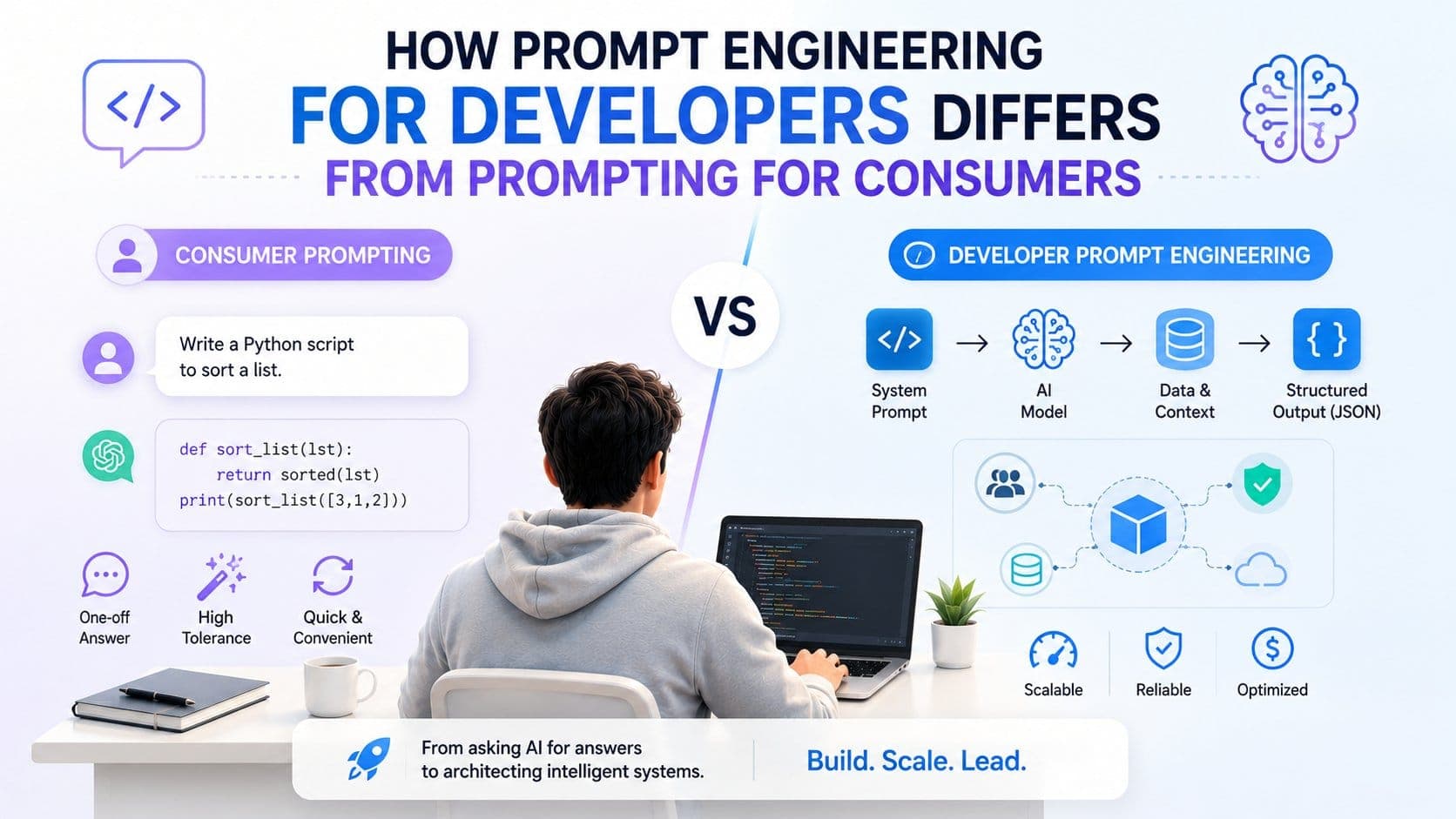
A regular consumer uses an AI tool, like Claude or ChatGPT like Google Search. They open a browser, simply type a question, and hope for a clear response—it’s more like having a conversation. This type of interaction breaks down into the following characteristics:
| Aspect | Consumer AI Interaction |
| The Goal | A single, isolated answer to a specific, one-off task (e.g., "Write a polite email telling my boss I'm calling in sick today"). |
| The Medium | A standard, web-based chat window UI where the user types a message, hits enter, and reads the output on screen. |
| The Tolerance for Error | Incredibly high. If the AI "hallucinates" a weird fact or uses an awkward phrase, the user simply deletes it or clicks "regenerate." |
If this is how you too interact with AI, then your CS degree is functionally obsolete. Anyone with a smartphone and an internet connection can type a casual question into a text box. This isn't engineering; it's basic digital literacy, and it won't get you a job in today's tech market.
For a software engineer, a prompt is more than just a casual conversation. It’s a code built inside a much larger, complex software system. When you build an AI-powered app, you aren’t just typing out a single question. You are designing a vast system handling millions of requests from real users every day—many of whom will accidentally or deliberately try to break it.
Here is how prompt engineering for developers actually differs from what regular consumers do:
| Concept | The Problem | The Developer's Mission |
| 1. Structured Data Output | Consumers love paragraphs, but software backends need strict JSON. If the AI adds conversational filler like "Sure, here is your data!", the app throws a fatal error and crashes. | Engineer rigorous prompts that force the model to output only valid data schemas. |
| 2. Predictability (Idempotency) | Regular code is predictable (2 + 2 = 4), but AI is probabilistic—it guesses the next word. Consumers like variety; developers view random variation as a system bug. | Fine-tune system instructions and temperature settings so the model behaves identically across thousands of user sessions. |
| 3. Latency & Token Optimization | Consumers don't mind a 5-second wait. In professional software, 5 seconds is an eternity. Every extra word costs "tokens," adding latency and burning company cash. | Keep prompts lean, brief, and highly precise to optimize speed and cost. |
The tech industry is changing rapidly and you won’t be able to keep up with the shift merely by typing random phrases into a chat box. If you want to turn your basic Computer Science degree into something more valuable, you need systematic training.
The PrepBytes Claude AI program powered by CollegeDekho can help you bridge this gap. Instead of guessing what words might work, you will learn the exact programmatic frameworks required to turn AI models into stable, production-ready software components through this short-term course.
Recent data shows that companies that have implemented Gen AI workflows now see 20-45% more productivity in engineering, depending on the complexity of the tasks. That’s the major reason why recruiters in 2026 are no longer looking for syntax writers. Instead, they are actively hiring engineers who can coordinate these models—connecting them to vector databases, setting up guardrails, and handling context windows.
| Feature | Consumer Prompting | Developer Prompt Engineering |
| Interface | Web-based chat UI | Codebases via APIs and SDKs |
| Input Style | Casual, conversational English | Structured system instructions, variables, and few-shot examples |
| Output Type | Text, summaries, or basic scripts | Strict JSON, Markdown, or specialized data objects |
| Focus | Instant personal utility | Scalability, security, error-handling, and cost management |
In order to stay relevant in the tech industry, you need to do more than just build standard e-commerce clones or generic mobile apps for your portfolio. Start building real projects that can prove your worth in the eyes of the recruiters.
| Portfolio Project Strategy | Practical Implementation |
| Build with Constraints | Write an application where the AI is strictly forbidden from using certain words, and build a testing script to try and force it to break. |
| Chain Multiple Prompts | Create a system where Output A from Model 1 is parsed, validated, and fed as Input B into Model 2. |
| Handle Errors Gracefully | Design a fallback system for when an AI API goes down or returns a corrupted response. |
Apply your theoretical knowledge and degree to solve real-world problems in software development. Stop talking to AI like a guide and start commanding it like architecture.