Trending
 Sakunth
 5 min read
July 8, 2026 | 6:34 PM
Stop wasting hours on repetitive 9-to-5 tasks. Scale your career by choosing an AI automation course that teaches agentic workflows, software integrations, and hands-on portfolio building.
Automating workflows is the future. If today you spend five hours doing repeated tasks in your 9-to-5, then your productivity becomes extremely low, and you have a high chance of getting replaced by an AI agent that does the same task in a fraction of the time. To be at the top of the pyramid, building AI automation agents is the way to go. You do not need to be a mathematical genius to build an AI automation tool; you just need the right guidance and support with enough practical knowledge to automate your rigorous tasks and save time and money for your company.
But with hundreds of AI automation courses online, here is how to choose the right AI automation course so that it helps you build a tangible portfolio and use the things that you have learnt immediately after you have learnt them.
Companies do not just want you to use AI as an assistant, but they want you to build AI models that help with repetitive tasks without human intervention so that your productivity comes up a notch. Learning AI automation gives you two immediate career advantages:
You do not need a PhD in mathematics or a computer science degree to automate your workflow using an AI Agent; however, you need to be highly aware of when coding is needed and when it is not, and which path you should take:
If you have absolutely no knowledge about coding, then you can go with the visual workflow builder path where you will learn to work with tools like Make.com, Zapier, and n8n.
If you already know some basic programming or want to build highly customized, complex systems, choose this track.
The internet is flooded with basic AI automation courses, but not every course is worth your money and time because some of them only touch the surface without having you go through practical practices of the things that you have learnt.
You can get a hundred AI certifications, but it will mean nothing if you are not able to crack a simple interview because you haven’t learned anything practical in those certification courses. An interviewer wants to know what you can actually build rather than how many certifications you have pasted on your LinkedIn account.
When looking for a course, check for these two green flags:
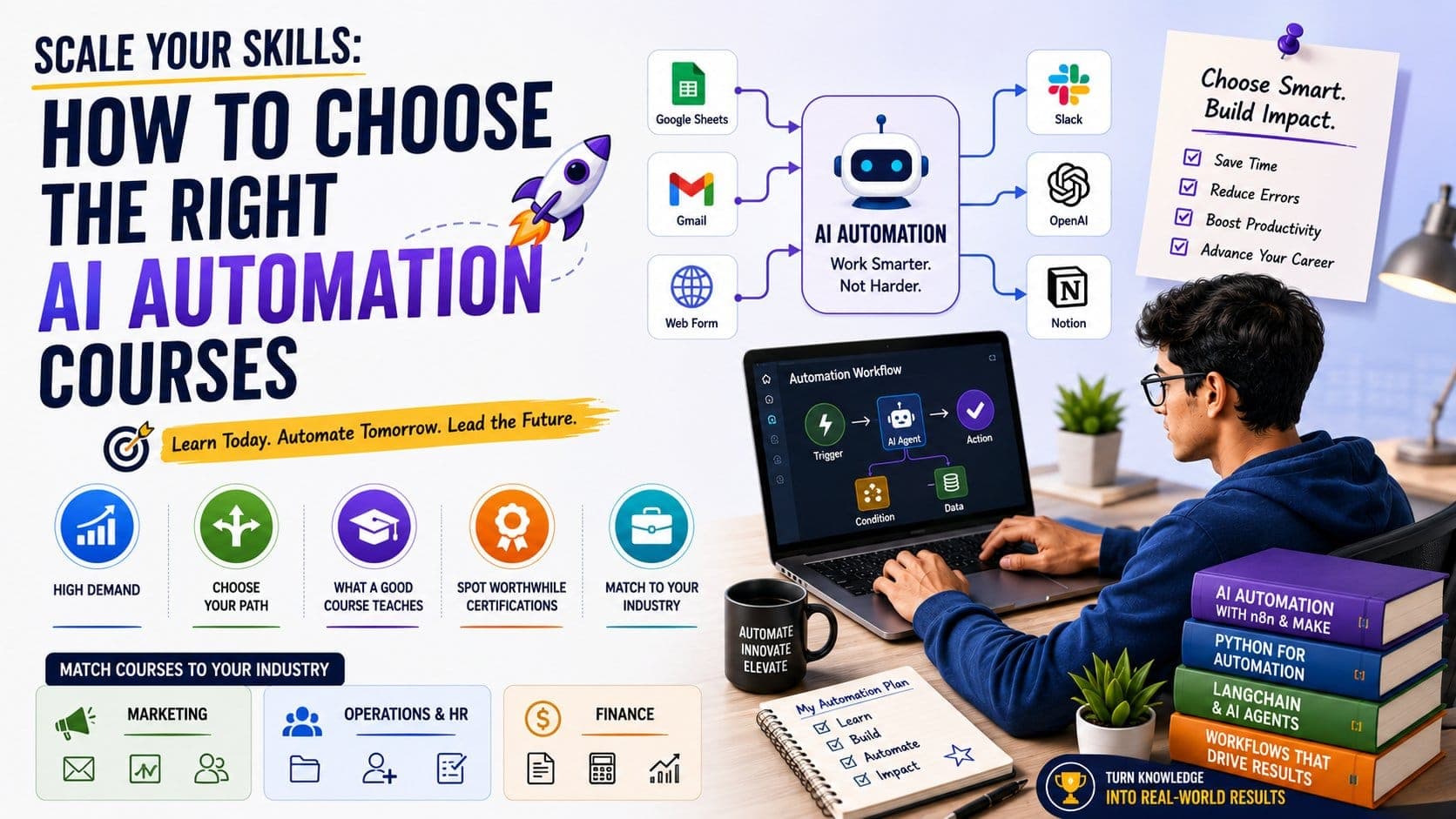
The best AI automation is the one you can use on Monday morning at your current job. Look for courses that offer templates or case studies specific to your field:
| Industry | What Your Automation Focus Should Be |
| Marketing | Automating social media scheduling, writing personalized email campaigns based on customer behavior, and scraping competitor data. |
| Operations & HR | Auto-sorting job applications, onboarding new employees, and organizing chaotic company files. |
| Finance | Automating invoice processing, cross-checking receipts, and flagging unusual account activity. |
The biggest mistake students make is finishing a course, closing the laptop, and waiting for a job offer. To get a real return on your investment, apply your skills. Immediately after completing your AI automation course, you need to use the knowledge that you have learnt and integrated into your 9-to-5. You can use your automation skills to automate one repetitive task of your daily work routine.
Once you successfully automate your own tasks, offer to build a small automation for a colleague or your manager.
When you use AI automation tools to your advantage, you can easily showcase them on your portfolio and become the most valuable employee who remains unaffected even when AI is killing all the other roles. The PrepBytes Claude AI for Campus course provides hands-on training instead of just theoretical fluff.