Trending
 Sakunth
 3 min read
July 13, 2026 | 5:08 PM
Tired of basic dashboards? Over 34% of entry-level engineering jobs now demand hybrid AI skills. Discover 7 top AI and ML courses to build live cloud systems and stand out to tech recruiters.
If you are writing basic SQL queries, building dashboards on Tableau, or running simple math formulas in Excel every day, then your career is in a very risky spot. AI coding assistants and tools can read data, spot trends, and create corporate charts in a split second. Due to this, tech companies are no longer paying high salaries to humans just to build dashboards.
If you’re in the final year of your B.Tech journey or a graduate fresh out of college, you need to level up. Tech companies are looking for Full-Stack AI Engineers—who don't just analyze old data charts, but actually build, tune, and launch live AI systems directly into the cloud.
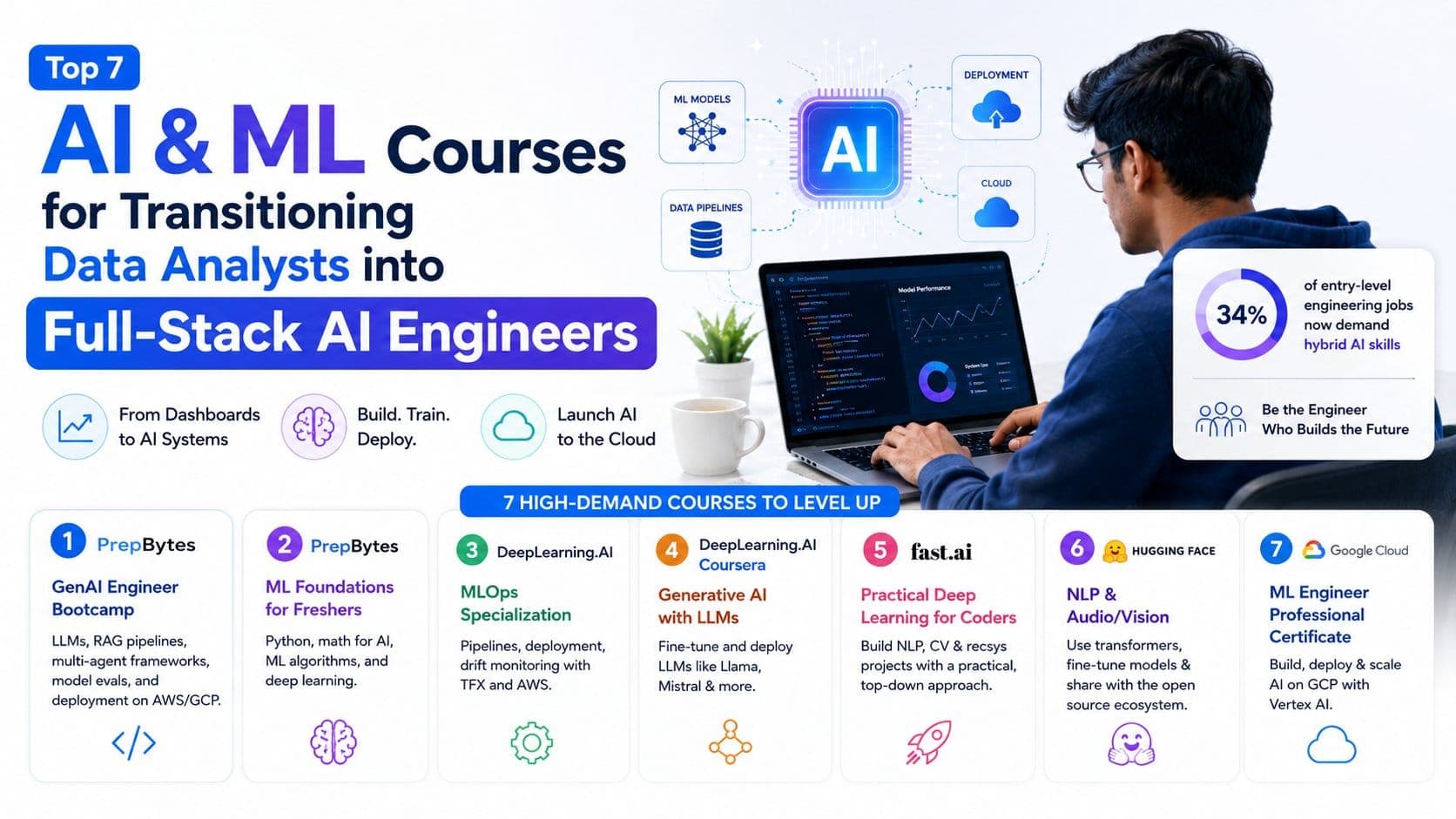
Data from recent hiring cycles indicate that over 34% of entry-level engineering jobs now demand hybrid AI skills. So, if you want to stand out in an interview or during campus placements, you need to upgrade yourself with these 7 high-demand AI and ML courses that will help you transform from a mediocre Data Analyst to an advanced Full Stack AI Engineer.
Here is a breakdown of the premier AI and ML programs to help you bridge the gap between simple data tracking and production-grade system building:
| Course | What You Learn | Why It Matters (The Reality) |
| 1. PrepBytes – GenAI Engineer Bootcamp | The 12-week intensive cohort focused on LLMs, building custom RAG pipelines, multi-agent frameworks, model evals, and deployment on AWS/GCP. | It bypasses surface-level prompting to build production-grade, model-agnostic enterprise applications with high-value live portfolios. |
| 2. PrepBytes – ML Foundations for Freshers | 8-week structured placement track covering Python foundations, mathematics for AI, classical machine learning algorithms, and deep learning. | Tailor-made for college students needing to bridge the gap between academic theory and active machine learning hiring tracks. |
| 3. DeepLearning.AI – MLOps Specialization | Data pipelines, containerized model deployment, drift monitoring, and engineering workflows via TensorFlow Extended (TFX) and AWS. | It shifts your mindset from treating machine learning as a math experiment to treating it as live, scalable software built for millions of concurrent users. |
| 4. Coursera & DeepLearning.AI – Generative AI with LLMs | The actual technical lifecycle of selecting, fine-tuning, and deploying heavy open-source LLMs (like Llama or Mistral). | Skips shallow prompt tutorials to focus on context windows, token budgeting, and the computational math behind scaling transformer systems. |
| 5. Fast.ai – Practical Deep Learning for Coders | A top-down approach where you build image classifiers, NLP tools, and recommendation systems on day one, analyzing math only when needed. | Strips away academic fluff to give you the practical execution speed that fast-moving tech startups actively prioritize over textbook certificates. |
| 6. Hugging Face – NLP & Audio/Vision Courses | Navigating the core open-source AI hub, utilizing the transformers library, fine-tuning models on custom data, and ecosystem sharing. | Teaches you how to leverage world-class, pre-trained models for custom corporate data—which is exactly how 90% of commercial AI products are built. |
| 7. Google Cloud – ML Engineer Professional Certificate | Building, training, deploying, and scaling enterprise AI architectures using Google Cloud Platform (GCP) and Vertex AI. | Tech recruiters trust cloud credentials over university GPAs because they prove you understand data privacy, cost management, and global scale. |
The job market today is incredibly competitive. Having a standard B.Tech degree or a generic portfolio is no longer enough to get past automated resume screenings.
Stop counting on basic reports and database queries. Instead, pick a practical, high-impact AI track, add live project links to your GitHub, and build the skills that make you irreplaceable in the industry.