Trending
 Sakunth
 5 min read
June 30, 2026 | 2:08 PM
AI hackathons are the fastest way to get noticed by recruiters. Stop wasting 48 hours debugging code. Learn how to use AI tools to rapidly build prototypes, analyze data, and pitch like a pro.
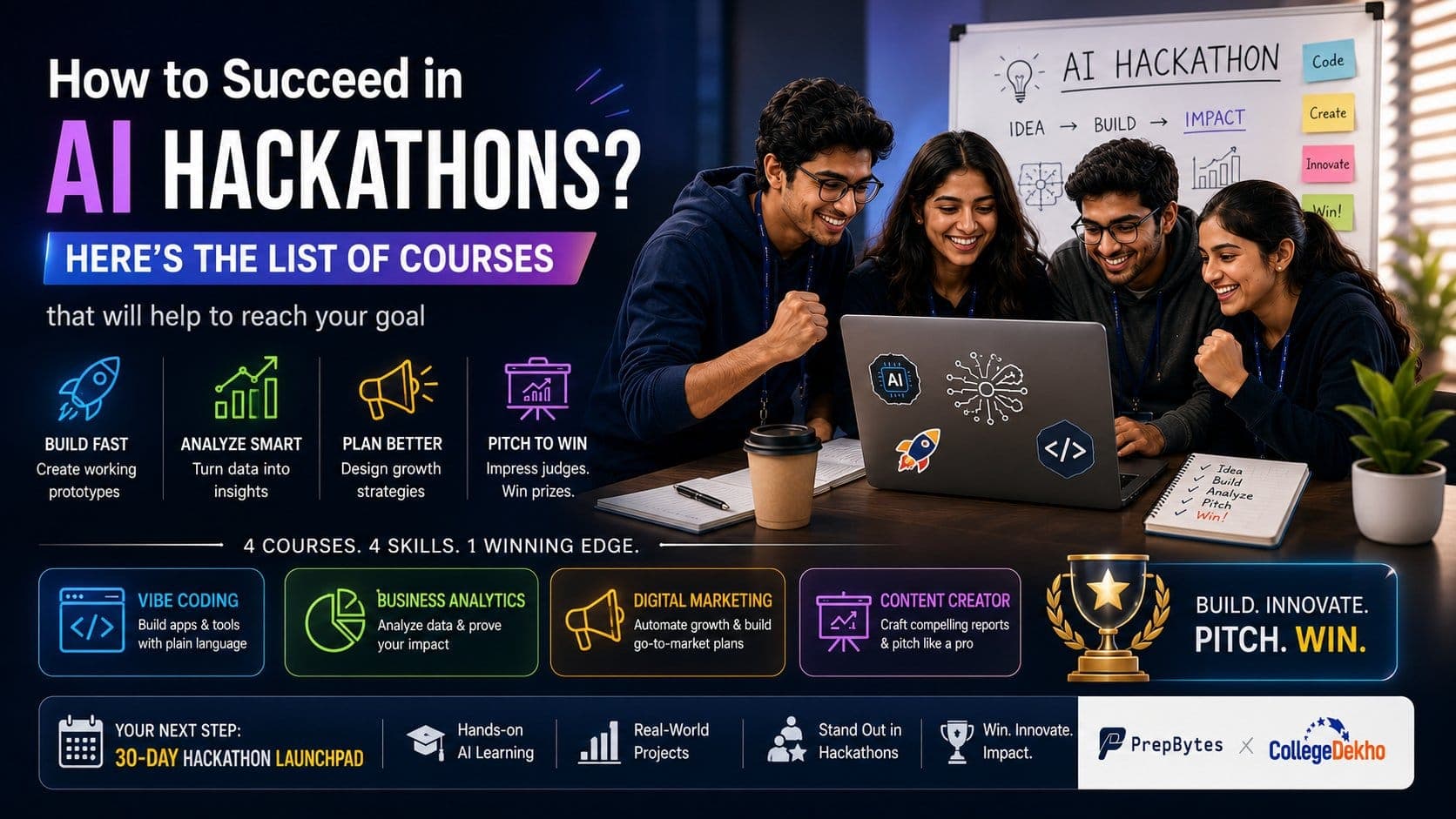
AI hackathons have completely changed the way tech and business professionals get noticed today. Participating in these events is the fastest way to grab the attention of the recruiters. Rather than being impressed by traditional resumes and generic skillsets, companies now value live projects and models that you build yourself to solve real business problems.
However, entering an AI hackathon without a clear strategy can backfire—most often students who are unprepared end up with broken code or an incomplete presentation when time runs out. To succeed, you need to know how to quickly build a working prototype, devise a business plan, and pitch it to the judges within the 48-hour timeline.
These four specialized online courses that can help you win your next AI hackathon and reach your goal ahead of time!
To win a hackathon, your team needs to ace each of these boxes—build a working application fast, analyze business metrics, create marketing assets, and make a flawless final presentation. You can master these specific steps using PrepBytes Claude AI programs:
Spending 36 hours trying to fix broken software syntax could cost your team—focus on the core idea instead. Hackathons value working models that actually solve a problem, not perfectly written lines of code. By using Vibe Coding, you can create fully functional apps and automated workflows by simply typing what you want in simple, everyday language.
| Blueprint Course | Core Audience | What You Will Learn | Hackathon Advantage |
| Claude AI for Vibe Coding (by PrepBytes) | Non-coders, beginners, and first-time builders looking to create software. | How to turn raw ideas into fully functional apps and web tools using plain, everyday language. | Bypass tedious code debugging to launch working prototypes rapidly under strict time constraints. |
Beyond just a working app, judges would want to know how your app can actually help people or save money in the business. To convince them, you have to take raw information off the internet, organize it quickly, and turn it into simple, easy-to-read charts. With clear numbers, you can prove how your project solves a major, expensive real-world problem.
| Blueprint Course | Core Audience | What You Will Learn | Hackathon Advantage |
| Claude AI for Business Analytics (by PrepBytes) | Professionals, analysts, and students looking to back up business ideas with hard data. | How to write SQL queries, interpret key performance indicators (KPIs), and use Claude as an analytical co-pilot. | Avoid manually combing through messy rows under pressure; instantly generate automated dashboards to prove your app's market value. |
To win a hackathon, you need to show the judges how you plan on reaching your first 10,000 users realistically using the tool. Teams that are able to present clear ad-copy pipelines and automated marketing strategies always have an edge.
| Blueprint Course | Core Audience | What You Will Learn | Hackathon Advantage |
| Claude AI for Digital Marketing (by PrepBytes) | Growth marketers, entrepreneurs, and students looking to master high-velocity launch strategies. | How to use AI to draft marketing blueprints, map user acquisition metrics, and execute rapid campaign strategies. | Build end-to-end digital growth loops and marketing funnels in minutes to present a bulletproof launch plan to judges. |
Once the 48-hour window is over, you typically have about 5 minutes to pitch your ideas to the judges—make the most of it. Make sure your slides are visually appealing, notes are organized, and the functionality of your app is well-explained; otherwise all the hard work will go to waste.
| Blueprint Course | Core Audience | What You Will Learn | Hackathon Advantage |
| Claude AI for Content Creators (by PrepBytes) | Writers, presenters, and professionals looking to polish their communication and documentation. | How to draft highly structured corporate reports, write concise project notes, and create persuasive presentations. | Turn a weekend's worth of complex work into a clean, compelling 3-minute pitch script that hooks judges and investors. |
While traditional coding methods can take longer than 48 hours, adopting an AI-first approach changes the entire game. Here is how the two frameworks compare when you are racing against time.
| Hackathon Stage | The Traditional Way | The Winning AI-First Framework |
| Development | Writing thousands of lines of manual code; wasting hours fixing minor bugs. | Using plain language to "vibe code" and deploy functional prototypes inside an afternoon. |
| Data Validation | Struggling with Excel or writing complex scripts to find basic user trends. | Prompting Claude to instantly clean raw datasets and extract valuable market insights. |
| Go-To-Market Plan | Guessing a business model or sketching basic bullet points on a whiteboard. | Leveraging marketing automation frameworks to map out full-scale launch loops. |
| Final Pitch Prep | Staring at a blank screen trying to format a presentation deck at the last minute. | Organizing clean documentation and structured project reports instantly using AI. |
Doesn’t matter whether you are a student or a working professional navigating the common entry point to these modern workflows. What you need is a solid foundation—the AI for Campus program by PrepBytes in association with CollegeDekho serves as a 30-day literacy program. You get hands-on experience using powerful AI tools, like Anthropic’s Claude, learning practical prompts, how to automate data sorting and present workflows that are sure to make you stand out in team activities, group discussions, and AI hackathons.