Trending
 Sakunth
 6 min read
July 14, 2026 | 5:07 PM
Traditional AI courses teach theory using clean datasets. But in the real world, data is messy and models fail. Learn why you must train on real-world business disasters to stay relevant.
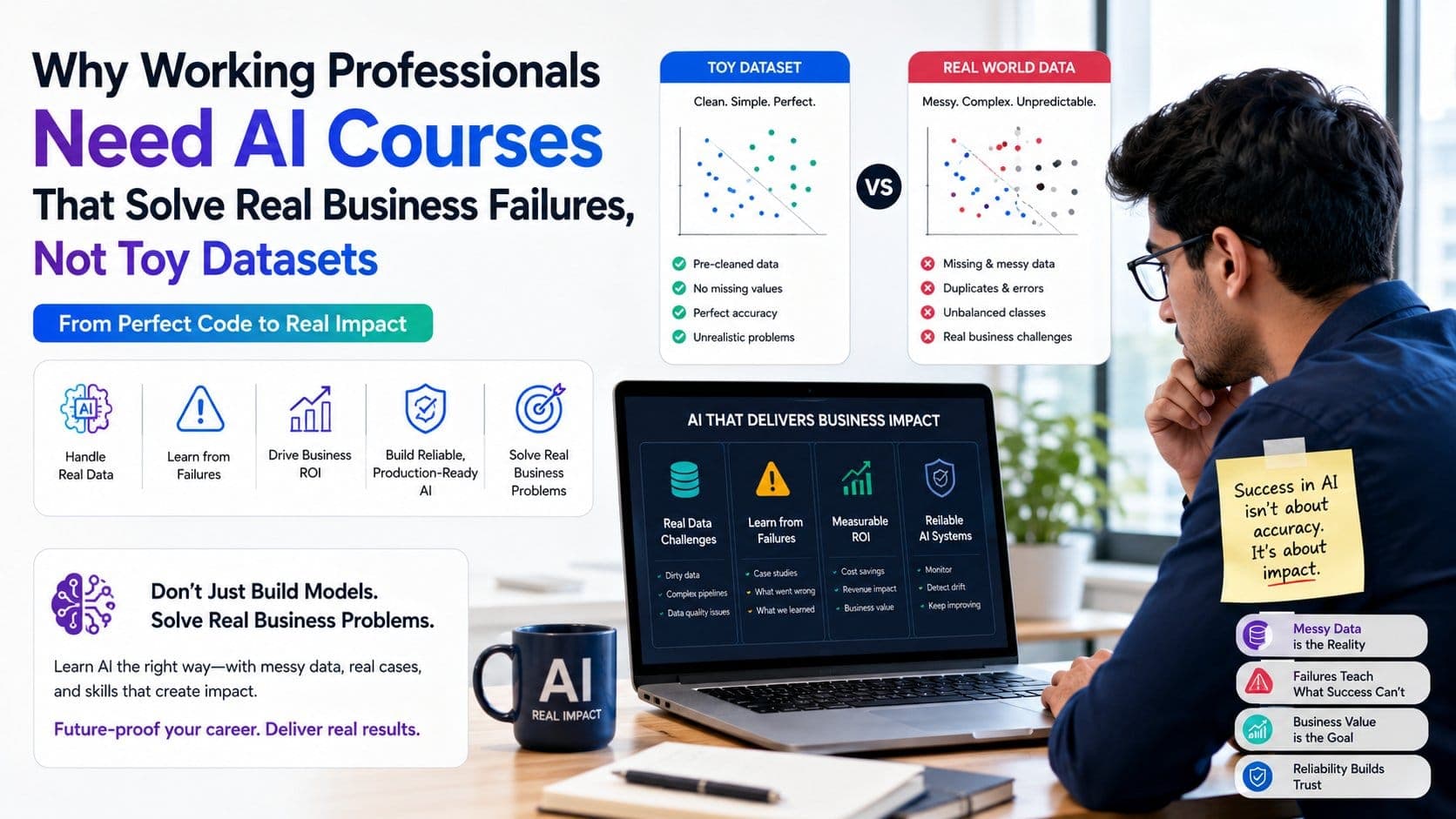
Working professionals need AI courses that solve real business failures, rather than traditional courses that work based on toy datasets. Usually, traditional courses provide you with theoretical knowledge about AI and data science while not exposing you to the real raw and messy datasets that are usually prevalent in the real world. Without hands-on training and little to no exposure to the real AI world, you step into your career unprepared and often panic when a complexity is thrown your way.
Here is a deep dive into why you need a futuristic AI course that gives you a reality check:
The majority of online AI courses are taught using "toy datasets." These are famous, pre-cleaned, and highly curated packages of data like the Titanic passenger list or the Iris flower dataset. They are designed to work perfectly. Because of this already perfect code, even when you write a few lines of code, your model comes up as perfect and runs smoothly. But when you do the real world, the story is completely different.
When you start working at a real company, you deal with a mountain of data, and it is not always presented neatly. In a real company, the data is divided into different databases, and you also have to duplicate entries with no clear timestamps; plus, it is filled with human error, which you have to pick out by hand. Reality hits hard when you are trained using toy datasets.
You lack the skills to build robust pipelines that can handle real-world irregularities. Working professionals need to learn how to wrangle "dirty" data, not just run algorithms on clean data.
Traditional AI courses that you see on the internet usually do not help you with the complexity of data because data is not always simple. According to industry estimates, data scientists spend up to 80% of their time simply cleaning, organizing, and preparing data. Data preparation is the most time-consuming and expensive step of AI.
When working through a traditional AI course, you are handed a set of data that is simple and categorised. In a real business, you have to ask yourself:
Traditional AI courses do not prepare you for the real world crisis but give you perfect problems to solve. As a professional, you need to have perfect knowledge about the economics of data, along with how to set up active labeling systems, and how to work with limited or expensive information.
Most AI courses help you understand the working of a successful model but fail to address the disasters. However, you learn more from things going wrong than things going right so that you can avoid those mistakes in the future.
A good AI course will help you go through some famous business failures to help you understand what went wrong and how you can learn from that. Consider these common business failures:
When courses focus on case studies of failure, professionals learn to ask critical questions before deploying code: Is our training data biased? Does our model understand the underlying economic reality, or is it just memorizing patterns?
Accuracy seems like the only metric that matters in real life, but in business even a model with a 99% accuracy can ruin your chances of success. In highly sensitive business models, like an AI model that is made to detect credit card fraud, a 99.9% accuracy is still harmful because almost all the transactions are legitimate, but only a minor percentage can be fraud that the model is looking for.
However, a useless model that simply guesses "NOT FRAUD" every single time will technically be 99.9% accurate. However, it will let every single actual fraudster slip through, costing the bank millions.
Working professionals must learn to translate technical metrics (like precision, recall, and F1-score) into business metrics (like cost savings, revenue generated, and customer satisfaction). A good and futuristic AI course will teach you how to build a business case for your model and calculate ROI.
Even after building a model and deploying it, your job has just begun. Because AI systems degrade over time, you need to constantly update them and check whether they are working fine or not. Additionally, when the real world changes an outdated AI model becomes less and less accurate over time. For example, a predictive model built to analyze consumer shopping habits before 2020 completely broke when the COVID-19 pandemic suddenly shifted global buying behaviors overnight.
When professionals do not know how to monitor models, set up automated alerts for drift, or establish retraining pipelines, they leave their companies vulnerable to sudden, silent failures. An AI professional who is trained with a futuristic course must know how to cover the discipline of machine learning operations to keep the models healthy and secure for a long time.
To be at the top of the game in an AI-driven economy, you cannot rely on standard traditional AI courses, which do not prepare you for the complexity that can arise when you are in the real world. You need to learn about AI projects where you manage raw data and turn it into useful inputs for AI tools.
A good AI course will help you face challenges, and you will learn how to debug failing models, handle chaotic data, design guardrails against bias, and align your AI systems with real business goals.