Trending
 Sakunth
 5 min read
July 6, 2026 | 4:27 PM
AI isn't taking your job, but an AI-fluent developer might. Discover why tech companies are ditching basic syntax writers and desperately hunting for engineers who can audit and direct automated tools.
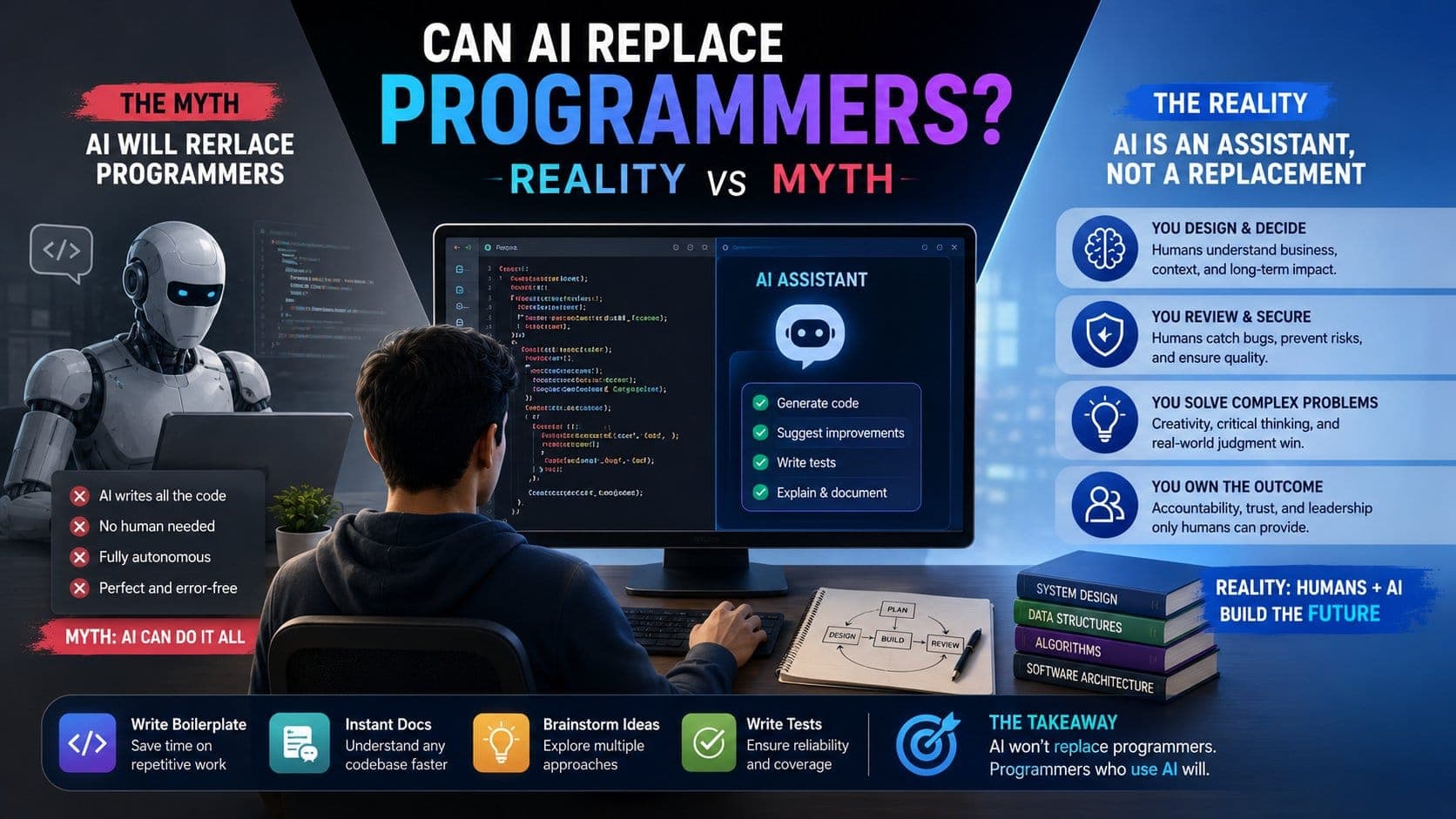
“Can AI Replace Programmers?” The answer is no. AI needs a commander to give clear instructions so that it can produce an output that is favourable to you; otherwise, it can hallucinate. The job of a programmer is no longer writing lines and lines of code and debugging the app if it crashes; now you need to be a reviewer and use AI as an assistant to code much faster than you would manually. This does not translate to AI replacing your job, but you need to integrate AI into your workflow to work much faster and save time and money for yourself and your company.
Let's bust some of the most common myths about AI replacing human jobs.
An AI model can write code pretty easily, but can it replace programmers completely? It is the question that is doing the rounds in everyone’s mind. The simple answer to the question is no; AI cannot take over coding anytime soon because a programmer does not only write a program but also generates ideas, solves complex logical problems, and ensures that the system is secure and efficient. AI can write code, but it cannot decide what to build, when to build it, and how to fix it.
AI models are also prone to hallucinations because they work on prediction rather than understanding. They might write code that works perfectly in isolation but breaks the moment you try to connect it to a larger app.
Developers use AI as an assistant rather than relying on it completely because it is very easy to make mistakes if you are using AI completely to do your job. It can boost efficiency but only if you use it smartly and fix the mistakes that it makes as you go. Modern developers use tools like GitHub Copilot, Cursor, or Gemini every single day to speed up their workflow.
Here is what using AI as an assistant looks like in practice:
Artificial intelligence cannot replace humans because there are some complex tasks that always require human intervention, like:
An AI can write a script for a single feature, but it cannot look at a giant enterprise system and figure out how it should evolve over the next five years. AI does not care if the code it writes today makes the app incredibly messy and hard to fix tomorrow. Humans have to manage this "technical debt" to keep software alive and maintainable.
Software is built for humans. Clients change their minds, business goals shift, and users behave in unpredictable ways. A human developer can sit in a meeting, understand the messy, unorganized needs of a client, and translate those chaotic human desires into clean logic. AI will need a clear set of instructions to give you an amazing output.
When a major app crashes at 3 AM, costing a company millions of dollars a minute, an AI cannot take accountability, log into the server, and creatively troubleshoot a unique, multi-layered bug. It takes human intuition, experience, and critical thinking to handle emergencies under pressure.
AI can only synthesize what already exists on the internet. If you are building a unique tech product, inventing a new data protocol, or solving a brand-new security flaw, AI cannot help you because it has no past data to copy from.
While AI cannot replace programmers, the job is indeed going through a major change because of the tool. We still need human developers, but there is a joint shift happening in the tech industry. Now, developers do not need to be syntax writers, but they are shifting towards being directors and reviewers of the code written by AI.
Now, developers are not sitting at their desks 24/7 to build an app and manually debug it, but using AI as an assistant to help with the tedious process. The modern programmer spends less time worrying about commas and brackets, and more time directing the AI, auditing its output, and designing how massive systems connect.
One of the biggest arguments for keeping human developers is that AI-generated code introduces unique risks. Because AI writes code so quickly, it can generate hundreds of lines of flawed code in seconds.
Recent studies and engineering reports show that blindly trusting AI code leads to a rise in security vulnerabilities and hidden bugs. Because the code looks clean on the surface, it can easily fool a non-expert. This makes the human programmer's role as an auditor and gatekeeper more vital than ever. You need deep expertise to spot the subtle logical errors that an AI confidently spits out.
The conclusion is that AI will never replace human programmers because it is a merely a tool that needs direction to give an output. However, because the tech space is changing, you need to be at the top of the pyramid to be an important person at your job; that is, you need to know how to use AI as an assistant and code faster.
Instead of a developer, you need to be an "AI-fluent" developer, a person who understands computer science fundamentals, knows how to design robust systems, and uses AI tools to work twice as fast as everyone else. If you are someone who wants to become a developer, do not forget to use AI as your assistant to be in a future-proof job.