Trending
 Sakunth
 5 min read
July 3, 2026 | 5:32 PM
Basic HTML, CSS, or Python syntax won't land you a job anymore. To survive the massive 2026 tech career shift, you must stop acting like a raw programmer and transform into an elite AI orchestrator.
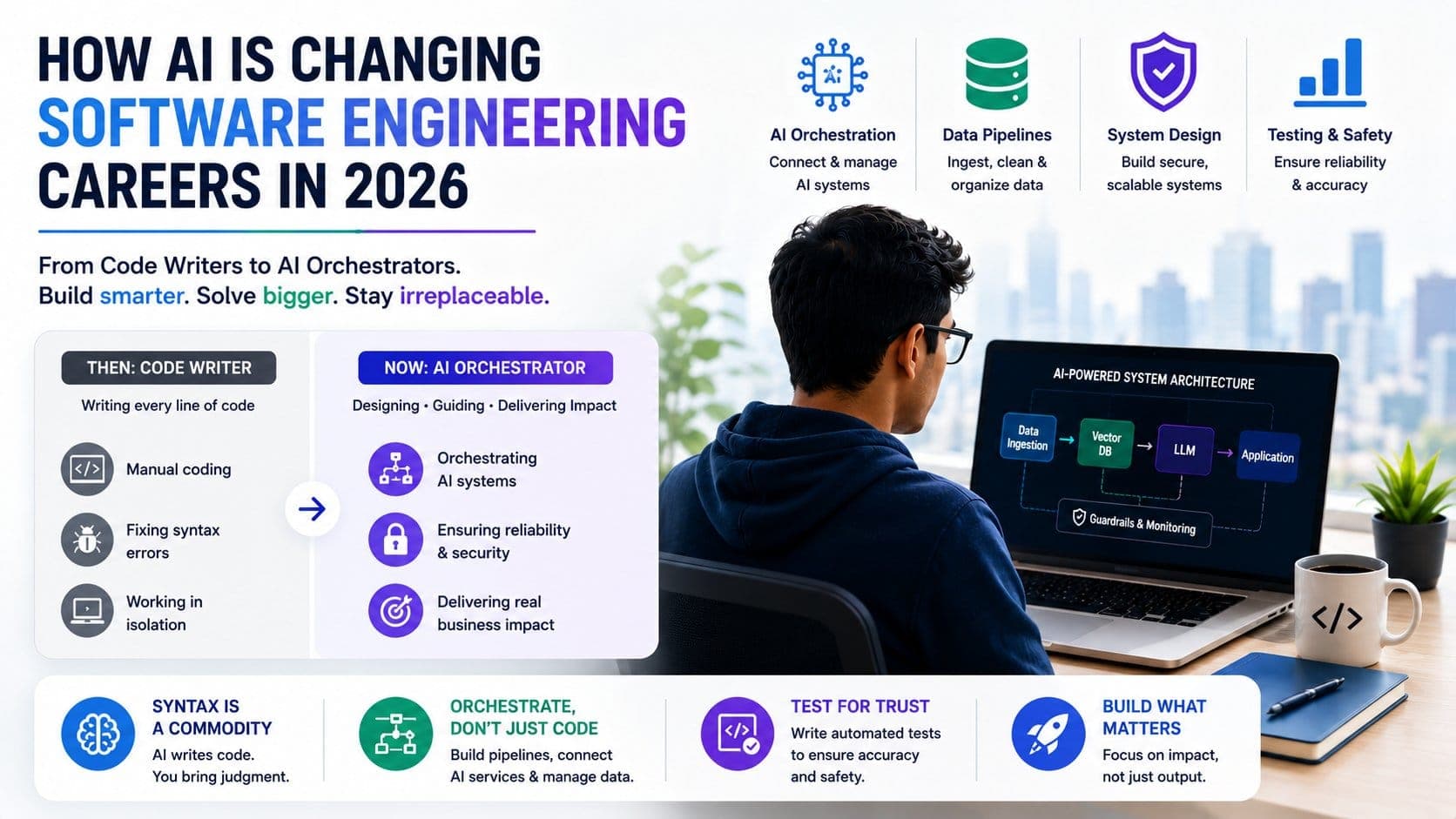
B.Tech students and engineering aspirants hoping to pursue a high-paying career in software engineering with just basic coding skills, like HTML, CSS, or Python may have to change their plans—the industry is dead. With AI taking over the global job market in 2026, the era of sitting comfortably at a desk turning instructions into raw code is officially over. AI tools can generate, debug, and enhance standard code syntax in microseconds.
So, to truly build a successful tech career today, you need to understand the huge career shift in software engineering happening right now.
Ten years back, "learning to code" meant memorizing rules, fixing semicolons, and spending hours writing basic loops. Getting a job was much easier if you knew how to type out functional syntax. But now, AI has disrupted that model completely. Today, the easiest part of software engineering is writing lines of code because a chatbot does it in a jiffy—so the definition and role of a traditional developer has changed.
Here is how the reality of software engineering career has shifted due to Artificial Intelligence:
Knowing programming syntax doesn’t make you valuable to recruiters anymore. AI models are now writing a huge chunk of the software used by companies globally. In fact, nearly half of all new code in major project libraries is AI-generated, and that number grows every single week.
Companies now value engineers who can review, organize, and secure that code. They pay you for acting like an editor and a systems architect—someone who can check the AI's work and figure out instantly how to safely glue all the pieces together.
Job postings are no longer about Full Stack Developers now; they are for Data Pipeline Engineers and AI Orchestrators. Companies are taking powerful AI systems that already exist and plugging them securely into their private company data—something known as a RAG system.
Since companies are building these systems, the future of your job in the tech industry will look different. You will majorly be responsible for the following:
There’s a massive difference between what an aspiring software engineer thinks of jobs nowadays and what tech companies actually demand.
| What Freshers Think is Enough | What the 2026 Market Demands |
| Writing a clean script locally | Optimizing code to reduce cloud API token costs |
| Building standard school projects | Setting up automated data pipelines |
| Knowing how to prompt a public chatbot | Programming strict system guardrails via APIs |
| Relying on a standard IDE compiler | Deploying containerized apps via Docker |
Normally, when a computer code breaks, the system pauses and shows an error message. You read the error, find the typo, and fix it. But when an AI system breaks, it doesn’t stop or flash any message. It keeps running but gives inaccurate or false answers with full confidence. This is where human software engineers are needed. You will have to write automated tests in Python to stress-test the AI over thousands of fake customer questions. If you fail to prove mathematically that your AI behaves predictably and safely under heavy traffic, companies will never let your code near their servers.
To survive the career shift due to AI, stop acting like a regular programmer and start working as a systems architect. Here’s how you can replace low-value automated tasks with valuable engineering skills that recruiters will pay for:
| The Wrong Move (Replace This) | The Smart Play (Build This Instead) | Why It Makes You a Valuable Asset |
Aiming for the low bar Building generic weather apps, simple calculator UIs, or cloning basic websites using YouTube tutorials. | Managing data chaos Building data pipelines that ingest messy, unformatted corporate text, clean it up automatically, and store it securely. | Free chatbots can generate basic app code in ten seconds. Recruiters see right through copy-pasted portfolios. They want engineers who can handle unpredictable, unstructured real-world data. |
Relying on basic code outputs Trusting that your script works just because it executed successfully once on your local machine. | Enforcing system safety Writing automated python testing suites that check your AI workflows for accuracy, safety, and hallucinations. | AI systems can fail silently by giving confidently incorrect answers. If you can mathematically prove your system behaves safely under heavy traffic, enterprises will trust your code. |
Ignoring infrastructure costs Blasting infinite queries to expensive cloud AI models without tracking efficiency. | Mastering token optimization Designing smart system architectures that minimize memory usage and slash cloud API costs. | Companies are drowning in cloud expenses. A developer who knows how to structure data efficiently to save the company thousands of dollars on API bills is incredibly valuable. |
The PrepBytes Claude AI for Vibe Coding Course is designed exactly for this career transition. Instead of spending hours struggling with typos, missing semicolons, and broken lines of code, this short-term AI course teaches you how to act like a manager directing an AI workforce. You will learn how to guide AI tools to handle the heavy lifting so you can build and launch real, professional software much faster than your peers.
The 2026 tech landscape isn't going to slow down. Relying on manual syntax typing in a world driven by automated execution is sure to make you irrelevant. Shift your focus from writing standard codes to managing complex data pipelines, and setting up strict system guidelines to become an irreplaceable architect. Remember, the tools might have changed, but the demand for skilled software engineers remains the same. So, stop typing and start building.