Trending
 Sakunth
 5 min read
July 13, 2026 | 5:30 PM
Basic code generation is a cheap commodity. With 34% of entry-level engineering roles demanding agent orchestration skills, learn how to manage autonomous Agentic AI workflows to stand out to recruiters.
Looking for a tech job straight out of college? Knowing basic programming, writing simple SQL queries, or using a chatbot to write codes is no longer enough to land a software engineer role. The job market is flooded with applicants because basic code generation has become incredibly cheap and easy for anyone to do. To secure a high-paying job, you need to move away from basic Gen AI tools to autonomous Agentic AI workflows.
Most students think they are using state-of-the-art technology with standard Gen AI tools, like ChatGPT or automated plug-ins. But honestly, it’s just a smarter version of the predictive text on your smartphone.
These Gen AI tools are essentially guessing engines. They look at what you are typing, compare it to millions of codes, and predict the next most likely characters.
Thus, there is not much scope since the AI can only see a tiny snippet of code. Moreover, these tools are highly dependent on you. They can’t function without you typing specific instructions or pressing keys. As the AI doesn’t fully understand your system, it often generates messy, repetitive codes that break other hidden files in your directory.
While these autocomplete tools surely help you churn out codes 50% faster, they also end up making too many errors or bugs in the software. That’s exactly why relying on Generative AI alone is not a great idea for an aspiring software engineer.
Think of Agentic AI as an independent remote worker. This new technology is redefining software engineering roles in the tech industry.
An Agentic AI doesn’t sit there guessing the next line of code; it acts on its own. You don’t need to give instructions, like “Write a piece of code to check an email address.” You can simply point out a broken software project to it and use a prompt, “Fix bug number 402 in our system tracker.”
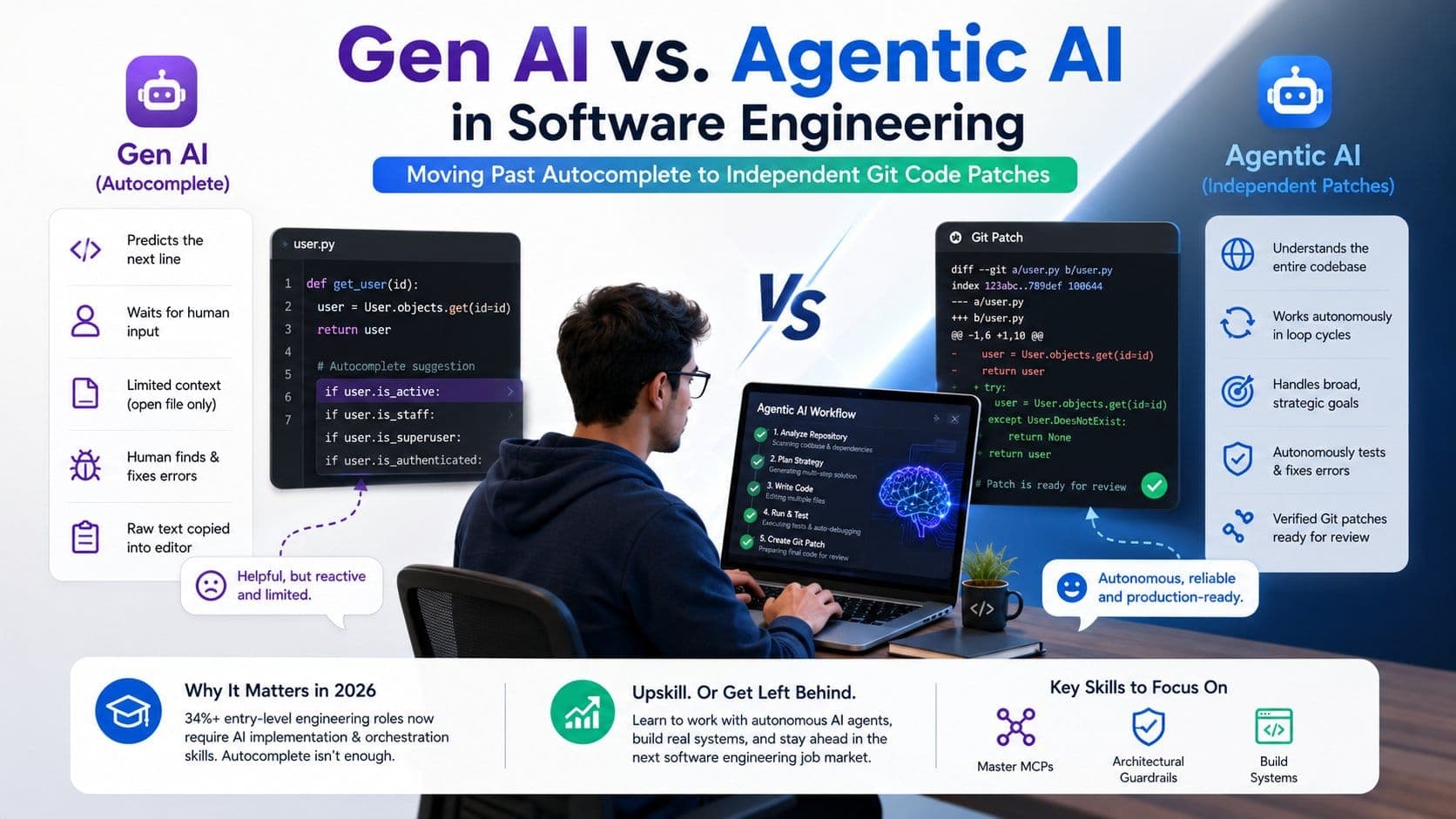
Here’s how an Agentic AI system works on its own to solve problems:
To get a suitable job and remain employed, you need to understand how Gen AI and Agentic AI compare in the real world:
| Feature | Generative AI (Autocomplete) | Agentic AI (Independent Patches) |
| Context Awareness | Limited to the open file or active tab. | Scans the entire global codebase and dependencies. |
| Operation Mode | Passive. Waits for human input line-by-line. | Active. Operates autonomously via loop cycles. |
| Goal Handling | Small, tactical tasks (e.g., writing a regex). | Broad, strategic goals (e.g., migrating a framework). |
| Error Correction | Relies on the human to spot and fix mistakes. | Runs test suites and auto-debugs its own code. |
| Output | Raw text blocks copied into an editor. | Verified Git code patches ready for production. |
With over 34% of entry-level engineering jobs now demanding implementation of AI skills and agent orchestration skills, simply copying code from a browser tab into a college project is not an option anymore. To bridge the gap between classroom theories and the practical tools dominating the modern software industry, you need hands-on AI literacy.
The PrepBytes Claude AI for Campus Program teaches you to move past basic prompting so you can learn how to coordinate multiple AI agents, launch software in live environments, and master the practical systems that recruiters are paying handsomely for today.
Here's how you can upgrade your skills to stay ahead in the game:
| Focus Area | What You Need to Do | Why It Matters (The Reality) |
| 1. Master Model Context Protocols (MCP) | Stop treating AI like an isolated web page. Learn how modern tools securely connect Large Language Models (LLMs) directly to local files, live coding environments, and database architectures. | It allows AI tools to see the full context of a business's entire system rather than working blindly in a vacuum. |
| 2. Learn Architectural Guardrails | Learn how to set up automated testing suites, continuous integration (CI/CD) pipelines, and safety filters to closely monitor what an AI agent produces. | When autonomous agents write code at a massive scale, things can break quickly. High-paying roles go to humans who keep the system safe and stable. |
| 3. Build "Systems," Not Snippets | Delete basic calculators and generic todo-list apps from your GitHub profile. Build an application using frameworks like LangChain or CrewAI that coordinates multiple AI agents to solve real business problems. | Anyone can generate a small piece of code using a chatbot. Top companies want engineers who can connect multiple AI pieces into a functioning ecosystem. |
Look beyond college exams and grades—learn to manage and direct autonomous AI agents, upload real projects and app links to your GitHub profile, and secure your spot in the next software engineering job market.