Trending
 Sakunth
 6 min read
July 10, 2026 | 1:01 PM
Using AI for basic emails is missing the point. In 2026, real business value lies in strategic integration—connecting AI directly to enterprise databases via RAG to automate complex, live workflows.
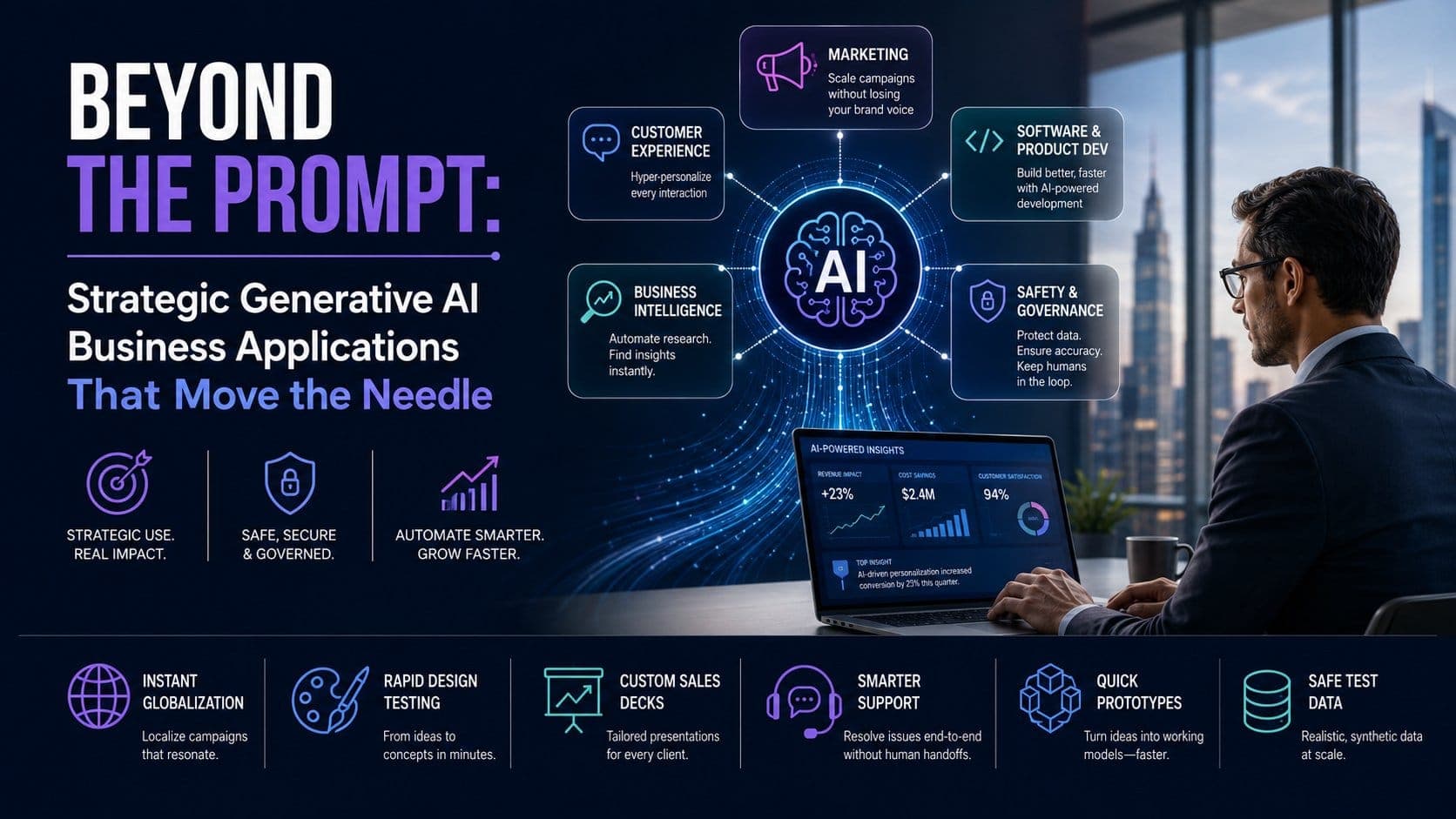
Everyone can use ChatGPT to answer emails, but businesses are not looking for people who use generic AI chatbots to do simple tasks faster. In 2026, every business is in need of professionals who can use AI strategically to enhance the overall productivity of the company and save time and money in the long run. Simply using AI can do more harm than good; you need to develop a plan to strategically integrate it in your workflow without compromising confidential company data.
Here are some Strategic Generative AI Business Applications That Move the Needle:
If you are using AI just to summarise emails and make PowerPoint presentations, then you are missing out; there is a huge difference between basic and strategic AI use:
When you use AI strategically, you are able to connect it directly into your company's database using a method called RAG (Retrieval-Augmented Generation). With the help of RAG, you are able to share your data with AI, and it can give you output based on the facts that you have shared with it.
Before 2026, AI was just used to write marketing blog posts or social media captions. Now companies are training AI to help build marketing pipelines focused on the brand identity so that the overall tonality of the marketing campaign is not compromised and every piece that goes out is aligned with the brand identity.
Without the help of AI, it becomes highly difficult to manage a bunch of clients at the same time, which means compromising quality for some clients and giving VIP treatment to only the biggest and highest-paying clients. All of this changes because of AI.
Because of AI, gone are the days of annoying chatbots that can only work with a handful of pre-set buttons. With the help of new tools, now AI can easily understand naturally written complaints typed by humans based on their personalized experience, and an AI chatbot can actually fix the problem instead of redirecting it to a human.
If a customer asks to swap a shirt for a smaller size, the AI doesn't just give instructions. It checks the warehouse inventory, starts the return ticket, holds the correct shirt size, and sends a confirmation text without any human intervention. Humans only step in if the customer gets angry or has a highly unique problem.
With the help of AI, coding only takes a fraction of the time it took two years ago. If you use AI strategically, then it will not work entirely on guesses but will look at an entire software system to find errors, make the code run faster, and write easy-to-read instruction manuals for the team.
Research done manually not only takes a lot of time, but it may not be efficient because of how tiring it is to look at lines and lines of data. Most of the time, insights are not retrieved efficiently because a particular person has to go through recorded phone calls, 50-page financial PDFs, legal contracts, and endless messaging threads to reach them.
Strategic AI acts like a super-fast researcher that reads everything your company has ever produced. You can then simply ask questions about your own business.
| What You Want to Know | Old Way | New AI Way |
| What Competitors Are Doing | Employees manually read rival websites and earnings reports every few months. | AI scanning competitor moves daily and sends a bulleted summary to executives. |
| How Customers Feel | Looking at a tiny sample of complaints or waiting for low-response surveys. | AI scanning 100% of emails and chats to instantly catch emerging product flaws. |
| Legal Due Diligence | Lawyers spend weeks reading thousands of pages of contracts before a merger. | AI scans the entire pile in hours to flag hidden risks or unusual penalties. |
AI looks tempting, but not everything can be shoved into an artificial intelligence chatbot. If you want to use AI safely, then you need to have strict rules and handle the risk that comes with it. The very first rule of deploying AI into your business model is to never trust it with your confidential customer data.
Never put your private company secrets or customer data into public, free AI tools. Doing so can cause that data to leak to the public.
By building a strong foundation of safety and connecting AI directly to your existing tools, your business can stop playing with basic prompts and start unlocking real, measurable value.