Trending
 Sakunth
 3 min read
July 9, 2026 | 4:01 PM
Recruiters in 2026 don’t care about textbook definitions—they want builders. Stand out by mastering RAG, MLOps, and vibe coding to secure entry-level packages up to ₹16 LPA even with an average GPA.
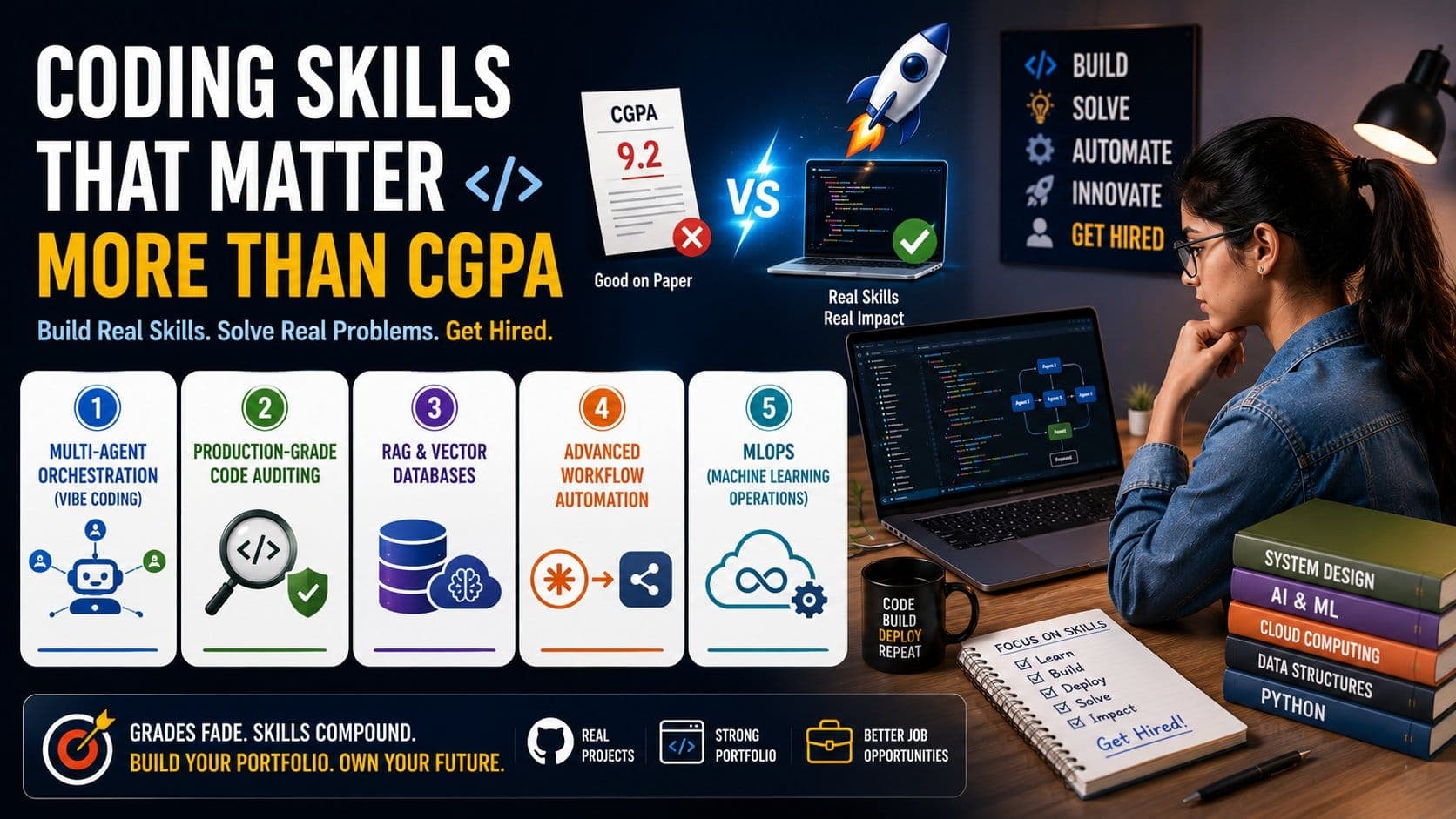
If you are an engineering student spending sleepless nights recalling boring textbook definitions of operating systems only to score a 9.5 CGPA, you are likely falling behind many of your peers who might be actually building something real. In 2026, recruiters don’t care if you can clone a perfect binary tree or a whiteboard. What they truly care about is whether you can build a scalable system leveraging advanced AI tools and technology.
Today AI coding assistants can write simple loops, debug syntax errors, and create boilerplate code better and faster than a fresh graduate. So why would a company pay a handsome package for a human compiler?
If you really want to land a well-paid job after graduation, stop relying on your CGPA and start mastering these high-demand AI coding skills that go far beyond your college syllabus.
Here are five coding skills that are highly demanded in today’s tech industry, and will get you guaranteed job even with an average CGPA:
| Top Coding Skills | Real-World Application | Target Job Roles | Average Entry-Level Package (India) | Why Recruiters Care More Than Your CGPA |
| 1. Multi-Agent Orchestration (Vibe Coding) | Deploying separate, autonomous AI workers to manage tasks like design, backend coding, and stress testing. | • AI Orchestrator • AI Automation Engineer • GenAI Developer | ₹8 – ₹15 LPA | It shifts you from a traditional line-by-line coder to a manager of an automated digital workforce, letting you finish massive projects 10x faster. |
| 2. Production-Grade Code Auditing | Reviewing AI-generated scripts to catch hidden security flaws, refactor syntax, and stop logic bugs. | • AI Quality Analyst • Code Reviewer (AI Track) • Trust & Safety Developer | ₹6 – ₹12 LPA | AI writes fast but generates massive amounts of broken code ("code churn"). Companies will pay you to ensure the software won't crash live. |
| 3. RAG & Vector Databases | Using frameworks like Pinecone or Chroma to safely feed private company documents to external AI models. | • RAG Developer • Data Engineer (AI Track) • AI Solutions Architect | ₹9 – ₹14 LPA | Over 34% of entry-level tech roles require this skill. It stops AI models from hallucinating or accidentally leaking confidential corporate secrets. |
| 4. Advanced Workflow Automation | Linking multiple software applications using n8n or Zapier APIs to eliminate manual human data entry. | • Systems Automation Lead • Operations Engineer • Workflow Architect | ₹7 – ₹13 LPA | Building automated customer and financial pipelines saves companies millions of dollars in human error and operational overhead. |
| 5. MLOps (Machine Learning Operations) | Packing local AI models into Docker containers and hosting them globally on cloud platforms like AWS or Azure. | • MLOps Engineer • LLM DevOps Specialist • Cloud AI Infrastructure Engineer | ₹10 – ₹16 LPA | Anyone can build a hobbyist tool on their laptop, but product-based companies desperately need engineers who know how to keep apps online for millions of live users. |
While college fundamentals are essential for core logic, they don’t prepare you to deploy an automated AI agent at a tech startup. To truly make a difference and be irreplaceable by chatbots, start building real apps that solve actual problems. Check out the PrepBytes Claude AI for Vibe Coding Program—this practical, hands-on launchpad is designed to train you to review and verify automated code and build production-ready systems right from the very first year of your college.
A clean resume highlighting a 9.0 CGPA sure looks fine, but a live GitHub repository with real project links and active applications is what actually impresses recruiters. So, don’t just focus on passing semesters with a good CGPA; pick any of the above AI coding skills, build a real-world tool and see offers pouring in as you demonstrate your potential.