Trending
 Sakunth
 4 min read
July 1, 2026 | 3:44 PM
Indian tech companies no longer pay for basic coding. To stand out, you must master AI-assisted code refactoring. Learn how to safely clean messy legacy code without crashing production systems.
Four years of your college education has surely taught you how to write a code; you can now balance a binary search tree in your sleep, and you know exactly what Big O notations mean. But just as you are about to enter the job market, you see companies demanding 3 years of experience working with AI tools that didn’t exist when you started college. Now what?
Here’s the harsh truth—the Indian job market has evolved rapidly. Nowadays tech companies are not keen on hiring employees only to type out basic codes. There are AI models who can do the job better in a jiffy. Instead, they are searching for skilled engineers who can figure out the flaws and bugs in an old messy code, and fix it using AI tools without crashing the company’s live systems—something more commonly known as AI-assisted code refactoring. Mastering this can make you look like a professional; but if you are unfamiliar with it, you may end up finding hidden bugs that can ruin your work and get you fired even before your probation is over.
Most freshers and graduates think of an AI assistant as a magic eraser. They take huge chunks of code, put it into a chat box, and ask ChatGPT or Claude to make it cleaner, then copy-paste the same response blindly back into their project—that’s NOT how you fix a code.
While an AI assistant surely speeds up the initial coding process by nearly 50%, it can actually deteriorate the overall quality of the software if not double-checked. Let’s talk real. Artificial Intelligence is designed to provide you with an answer or solution; but it doesn’t necessarily mean that all the answers and responses are 100% correct. If you allow the AI model to rewrite everything at once, it might subtly change the way your app interacts with the database without you knowing until the whole system crashes.
To survive the tech market, stop using AI like a consumer chatbot and start treating it like a high-powered intern. Instead of accepting everything the AI provides you with; build a strict box around it to keep it from breaking things.
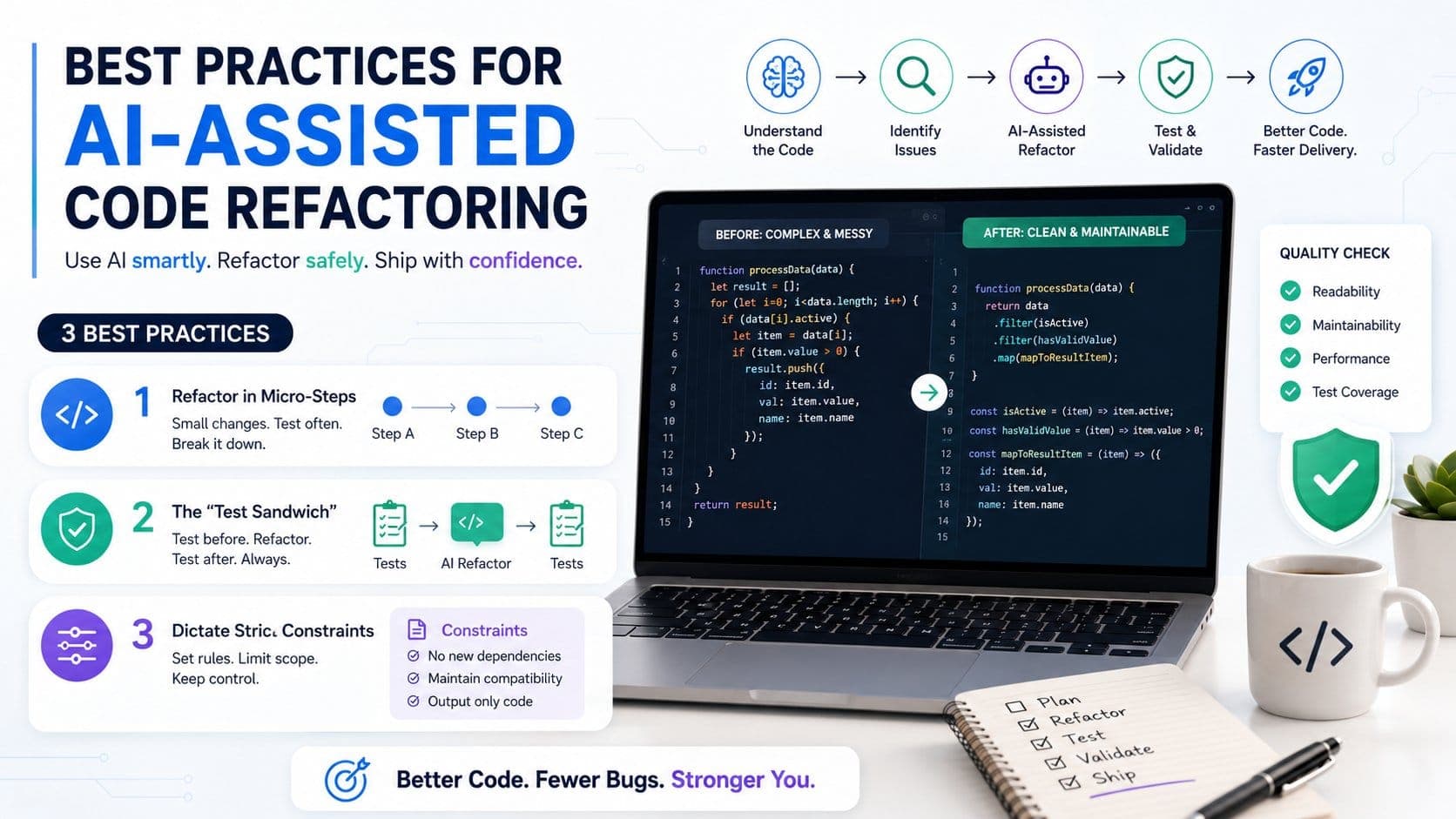
Mastering AI-Assisted Code Refactoring requires shifting from mindless copy-pasting to a more structured execution. Follow these three best practices:
| Strategy | The Core Rule | Step-by-Step Execution |
| 1. Refactor in Micro-Steps | Stop feeding giant files to the AI. Large context windows make developers lazy. Break your refactoring down into atomic, isolated changes so if something breaks, you know exactly which micro-prompt caused it. | Step A: Ask the AI only to rename poorly labeled variables for clarity. Run your tests. Step B: Ask it to extract a single nested loop into its own helper function. Run your tests again. Step C: Ask it to update the error handling. Run your tests a third time. |
| 2. The "Test Sandwich" | Never ask an AI to refactor code that doesn’t have automated tests covering it. If you don't have unit tests, your first prompt shouldn't be to refactor—it should be to force the AI to write the test suite. | Run existing unit tests on the messy legacy code to ensure they pass. Prompt the AI to refactor a specific, isolated block of that code. Run the exact same unit tests on the new AI-generated code. If they don't match perfectly, reject it instantly. |
| 3. Dictate Strict Constraints | AI models love to rewrite code using whatever flavor-of-the-month framework they prefer. You must be the boss of the architecture by inserting strict constraints directly into your prompt. | Use a system prompt template like this: Refactor the following function to reduce cognitive complexity. Constraints:
|
| What the AI Wants to Do | What You Must Force It to Do |
| Rewrite the whole file from scratch | Modify only the targeted function |
| Add conversational explanations | Return raw, parseable code |
| Use obscure, "clever" one-liners | Prioritize explicit readability for your team |
The PrepBytes Claude AI for Campus program powered by CollegeDekho trains you on how to transition from standard automation and build a programmatic understanding of AI systems. It gives you the structural edge needed to handle codebases before you even step into an interview room.
So, the next time you walk in for an interview, don’t just say you’d use AI to fix codes. Demonstrate how exactly you would bind the AI with strict constraints, run a quick test on the old code to see if it works, and roll it out into micro-steps.