Trending
 Sakunth
 6 min read
July 6, 2026 | 4:45 PM
Writing basic code is no longer a marketable skill. To land high-paying roles, you must move past traditional syntax and master AI-assisted coding skills like terminal agents and code auditing.
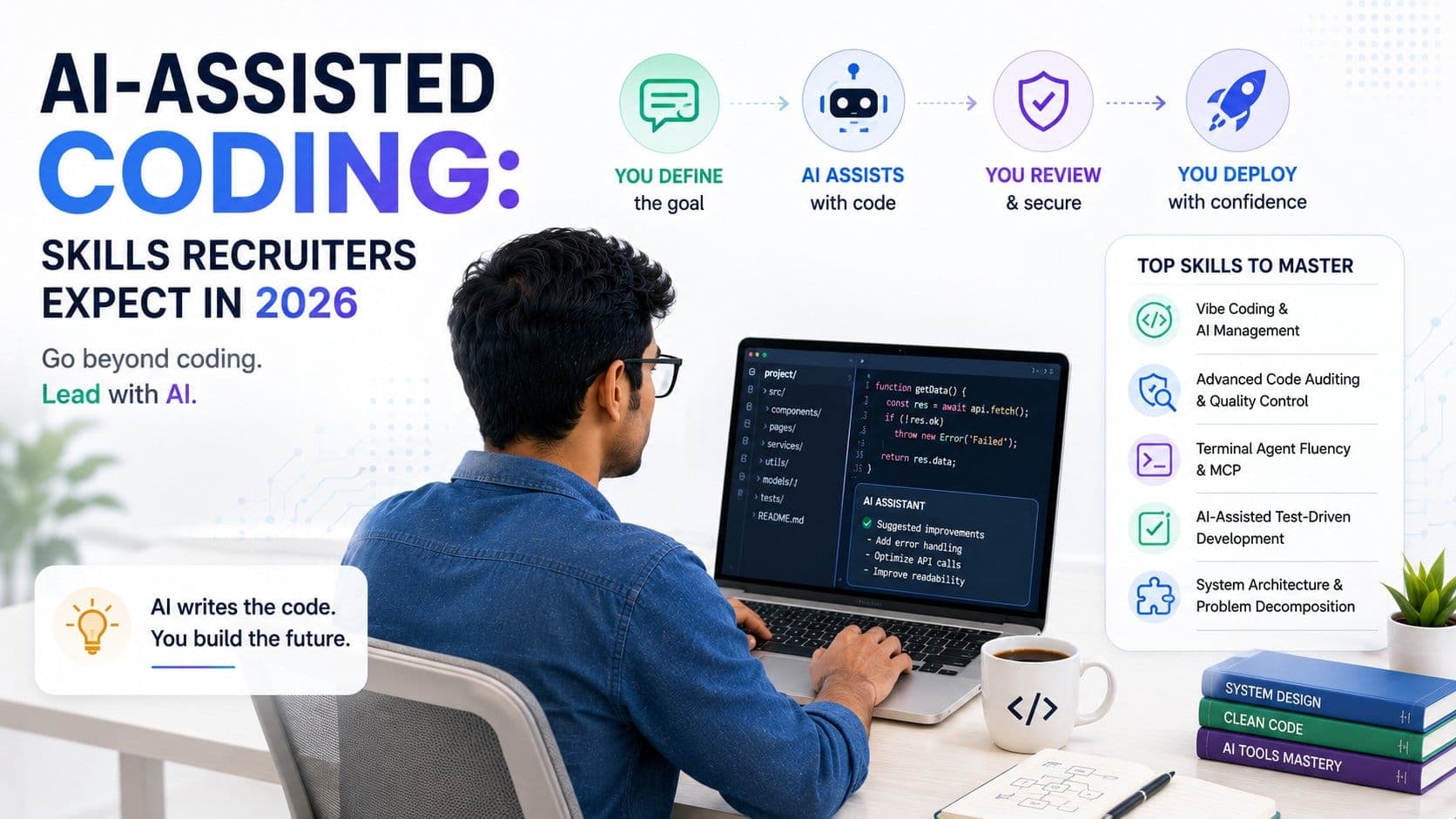
The tech job market has shifted drastically since 2021, thanks to the era of the AI! Standing in 2026, knowing how to write basic code is no longer considered a marketable skill. Recent data shows that nearly 84% of modern developers now leverage AI coding tools in their daily workflows. A standard chatbot can produce a Python script or a clean React component in seconds.
Recruiters don’t pay huge salaries to employees who act like expensive spell-checkers for code. What they demand is an engineer who knows exactly how to guide, verify, and manage an automated stack of AI tools. So, if you want your resume to stand out and build a successful tech career that survives company-wide layoffs, master these five AI-assisted coding skills right now!
Gone are the days when you could simply copy-paste short snippets of code from a chatbot into your computer. Professionals today learn and practice “Vibe Coding”—where you use natural language to direct an AI assistant in creating, refining, and deploying an application, rather than writing code line-by-line
Here’s how it works:
| The New Way (Vibe Coding & AI Management) | Why This Matters to Employers |
| You give an AI agent a major goal (e.g., "Add a secure checkout page"). The AI autonomously opens, reads, and edits your frontend, backend, and database files all at once. | Massive Speed Boost: Teams using AI agents build software in hours instead of weeks. Companies want managers who can handle this speed. |
| You spend your time auditing the AI's logic, setting safety boundaries, and making sure the AI doesn't break other parts of the system. | System Architecture: If you don't know how to organize your project files so the AI can read them without getting confused, the AI will spin out of control. |
The PrepBytes Claude AI for Vibe Coding Course powered by CollegeDekho bridges this gap—moving past boring textbook theories and exposing you to the real-world programming setups. You can transform from being a coder to an AI manager leveraging the exact tools and workflows that recruiters are desperate to hire in 2026.
AI surely writes code faster, but it doesn't always write good code. Ever since AI tools became more popular, the percentage of code that has to be rewritten or discarded because it broke something has nearly doubled.
Since AI is prone to making mistakes so quickly, tech companies are desperately looking for engineers with excellent code auditing skills—one who can review code, identify the errors, and fix them before they go live.
| The New Expectation (AI Auditing) | Why It Keeps You Employed |
| Let the AI generate hundreds of lines of code in seconds, then step in as the expert to spot hidden logical flaws, security gaps, and performance bugs. | Risk Management: Running bad AI code can crash a company's website or leak customer data. Companies will pay a premium for you to be their safety shield. |
| Review an AI's work just like a human senior manager would—tearing apart its suggestions and optimizing the code so it runs efficiently. | Quality Control: Anyone can press "generate" on a chatbot. Recruiters screen heavily for engineers who know exactly why a piece of AI code is bad and how to fix it. |
Tech companies now expect you to run directly into the computer’s terminal using AI tools. To prove your worth, you need to understand the Model Context Protocol (MCP). Think of it as a digital passport that allows an AI tool to safely look at the folders in your computer, run tests to find out if the software works fine, and extract data from the company’s databases.
| Using AI in the Terminal (The New Standard) | Why It Matters to Recruiters |
| Instead of opening a web browser, you type commands directly into your system. The AI automatically scans your local project files and fixes bugs right where they live. | Professional Efficiency: Companies do not want you wasting hours manually copying files into a web browser. They want engineers who can run AI directly inside the company's existing secure workspace. |
| You use MCP to safely connect the AI to local testing tools and company databases without exposing sensitive security data. | Data Security: Recruiters actively look for professionals who know how to grant AI tools the exact right permissions—allowing the AI to do its job without accidentally leaking private company code. |
Today, hiring managers expect you to adopt a new approach called AI-Assisted Test-Driven Development (TDD) rather than writing tests manually to make sure the software works accurately. You just tell the AI in the simplest language what you want the app to do, have it build the tests, and then let it write the code to pass those tests.
Here’s how it works:
| The Modern AI Testing Workflow | Why Recruiters Demand This Skill |
| Step 1: Describe the Goal — You explain exactly how the feature should behave using simple English commands. | Eliminates Human Error: By defining the rules in plain English first, you ensure the AI doesn't get sidetracked or build the wrong thing. |
| Step 2: AI Writes the Tests — The AI agent creates the testing parameters to verify that your English instructions are met. | Guarantees Quality: Building the tests first sets up a digital "checkpoint." The software cannot move forward unless it is absolutely flawless. |
| Step 3: AI Writes the Code — The AI writes the exact code needed to pass those tests successfully. | Unmatched Speed: If you don't know how to run this fast testing loop, you won't be able to keep up with the rapid development speeds modern tech companies expect. |
With an AI assistant handling the job of typing codes for you, your true value now comes from your ability to think logically and organize data. Companies are paying higher salaries for problem decomposition—which refers to the skill where you take a massive, messy real–world business problem and break it down into small, logical steps that an AI can actually understand and build.
| Skill Dimension | The Low-Value Developer | The High-Paid 2026 Engineer |
| Primary Task | Spends hours typing boilerplate code and fixing missing commas. | Focuses on system architecture, data flow design, and security guardrails. |
| AI Utilization | Uses AI like a basic search engine to find code shortcuts. | Employs teams of coordinated AI agents to build entire features over days. |
| Core Value | Easily replaced by any automated script or cheaper junior dev. | Irreplaceable because they hold the blueprint and logical overview of the system. |
Companies are not targeting software engineers; they are singling out developers who are incapable of evolving and learning AI-assisted coding skills. So, without wasting further time, master these modern AI tools, build a portfolio of apps that work across multiple files, and prove to recruiters that you know how to manage the technology instead of just letting it replace you.