Trending
 Sakunth
 4 min read
July 15, 2026 | 5:46 PM
Tech hierarchies are crumbling. With "vibe coding" tools like Cursor, Product Managers can now prompt fully working apps into existence, blurring the line between planning and engineering.
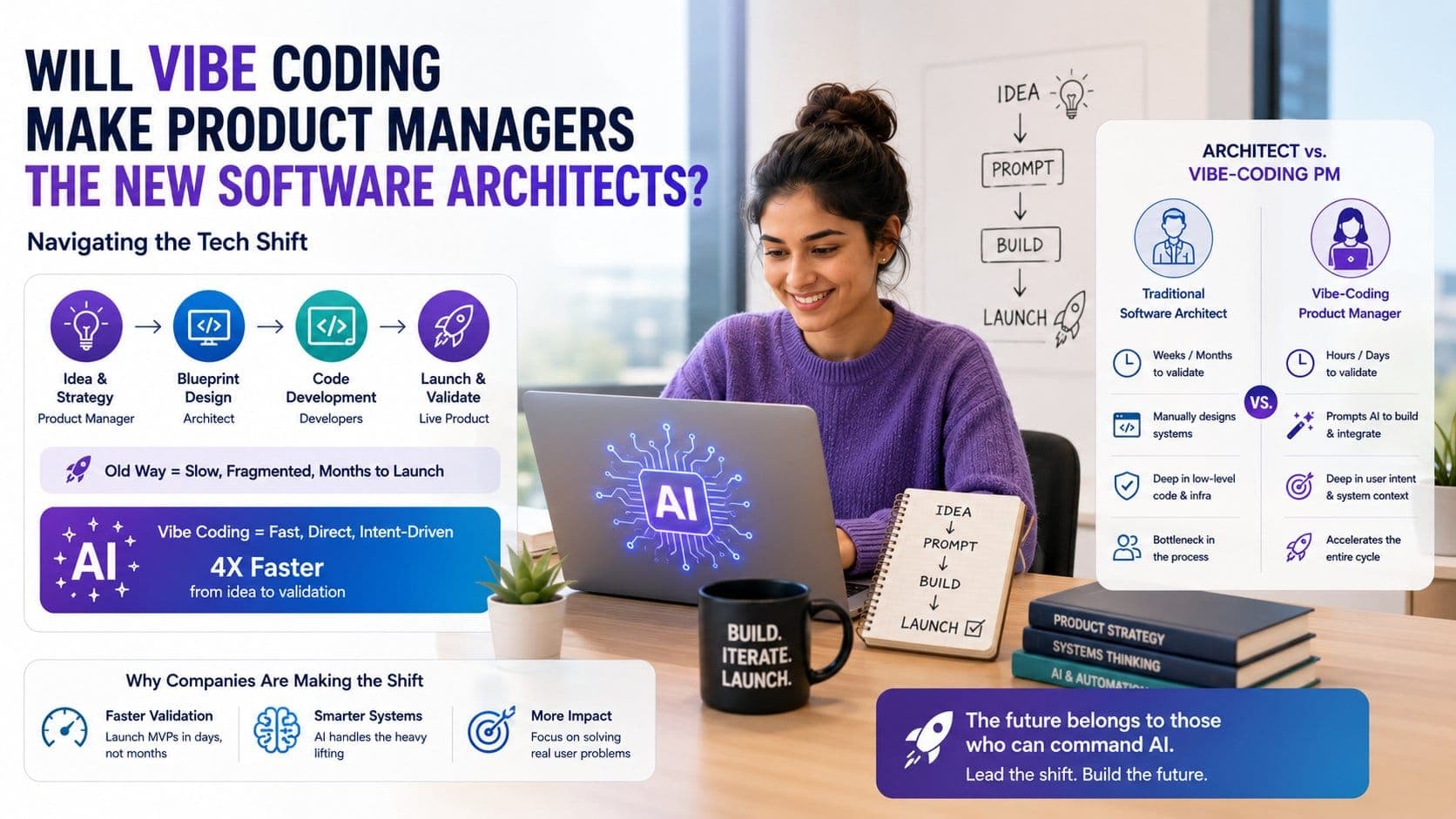
Traditional tech hierarchies are crumbling. Until recently, there were two clearly defined roles: Product Managers (PMs) who took note of what users wanted, and Software Architects who drew the technical blueprints and passed them on to junior developers to type out the code line-by-line.
Then “Vibe Coding” came and flipped the script totally—Vibe coding allows you to build software without actually typing a code. You can just prompt smart AI tools what exactly you want, and it will build, test, and launch the entire application for you. Today, Product Managers are using Cursor, Replit Agent, and other AI tools to create fully working apps over the weekend. It raises an important question: Will Product Managers replace traditional Software Architects completely?
What really slows down the software development process is not the typing speed; it’s the information that gets lost midway. Normally, a Product Manager explains an idea to a technical designer, who sketches a blueprint and hands it over to the code to turn it into software. The original plan gets distorted at every stage.
With Vibe coding, since AI allows a PM to build a database or a live app using simple English, you are no longer just managing schedules—you are building the system on your own. Companies that are using AI coding assistants are able to launch initial products 4 x faster than before.
If your entire career plan relies on simply translating text instructions into basic computer code, you are lagging far behind. Today's tech market favours those who know how to direct AI systems rather than memorize programming rules and syntax.
The PrepBytes AI for Vibe Coding Program teaches you the exact practical skills needed to design smart AI workflows, control advanced software agents, and build real applications using simple prompts.
To understand this tech shift, here’s a comparison between traditional Software Architects and new-age, AI-advanced Product Managers:
| Design Attribute | Traditional Software Architect | Vibe-Coding Product Manager |
| Primary Workflow | Manual design of microservices, API contracts, and database schemas. | Intent-driven prompting of AI systems to generate functional backends. |
| Speed to Validation | Weeks or months spent drafting blueprints and getting alignment. | Hours to days. Spins up a live URL with active database integrations. |
| Core Competency | Deep understanding of low-level code compilation and hardware limits. | Deep understanding of user intent, business constraints, and system context. |
| Bottleneck Factor | High. Engineering teams wait on architecture reviews to begin writing code. | Low. Bypasses initial engineering lines to test user experience immediately. |
While AI coding makes the job incredibly faster, left unsupervised, an AI might build a payment page without adhering to security laws, data privacy, and budget limits. This is where a tech leader steps in. The job is not just drawing diagrams on a whiteboard; the real job is to feed the AI the exact rules, security boundaries, and the necessary instructions so the generated code doesn't crash the company's entire network.
To stay ahead of your peers, you need to start thinking like a professional who can bridge the gap between business strategy and AI systems management. Build a strong portfolio using this blueprint:
| Action Plan | What to Stop Doing | What to Start Doing (The Survival Skill) |
| 1. Focus on Context, Not Code | Spending months memorizing basic programming languages and copy-pasting boilerplate code. | Learning how systems talk to each other (APIs), how vector databases organize data, and how to feed precise rules into an AI. |
| 2. Build End-to-End Prototypes | Building static, simple websites or basic calculators that don't do anything dynamic. | Building micro-apps that connect to real cloud environments, read active databases, and solve user problems automatically. |
| 3. Master System Auditing | Assuming the AI's first draft of code is perfect and secure. | Learning to spot what the AI missed (like security loopholes or budget-wasting code) and guiding the AI agent to fix its own mistakes safely. |
The boundary between someone who plans an app and who codes it is disappearing with each passing day; you don’t need to wait for weeks to write software. Learn how to command and guide AI tools to remain irreplaceable in the tech industry.