Trending
 Sakunth
 5 min read
July 14, 2026 | 5:23 PM
Hackers breach networks in under 30 minutes. Ditch basic chatbots and master Agentic AI—smart systems that detect threats, rewrite broken code, and deploy live security patches automatically.
Gone are the days when Cybersecurity engineers could simply sit at a desk, manually checking log files and writing basic firewall rules—that career path is dead. Cybercriminals are no longer writing hacking codes line-by-line; they are deploying aggressive AI tools to break into the system in a fraction of seconds. In fact, hackers can now take over key systems in less than 30 minutes. An average team of humans countering this threat takes weeks or even months to patch a software bug. Thus, in today's fast-paced world, relying on slow human response times is a massive risk.
To get a high-paying job, you need to look past basic chatbots that just write text. You must learn how to build and control smart, autonomous Agentic AI— systems that can detect threats, fix loopholes in the security system, and push live code updates independently, without human intervention.
Most Computer Science students think they are doing great work when they write a short script or summarize a security report using a basic chatbot. Agentic AI changes this scenario completely—it observes, analyzes, and acts on its own. You don’t need to prompt for every little task. Instead, you give it an operational objective, like: "Keep our cloud network secure and automatically fix any major security bugs the second they appear."
To get noticed by the recruiter and bypass automated resume screeners, you must understand how an automated AI security pipeline actually operates in the real world.
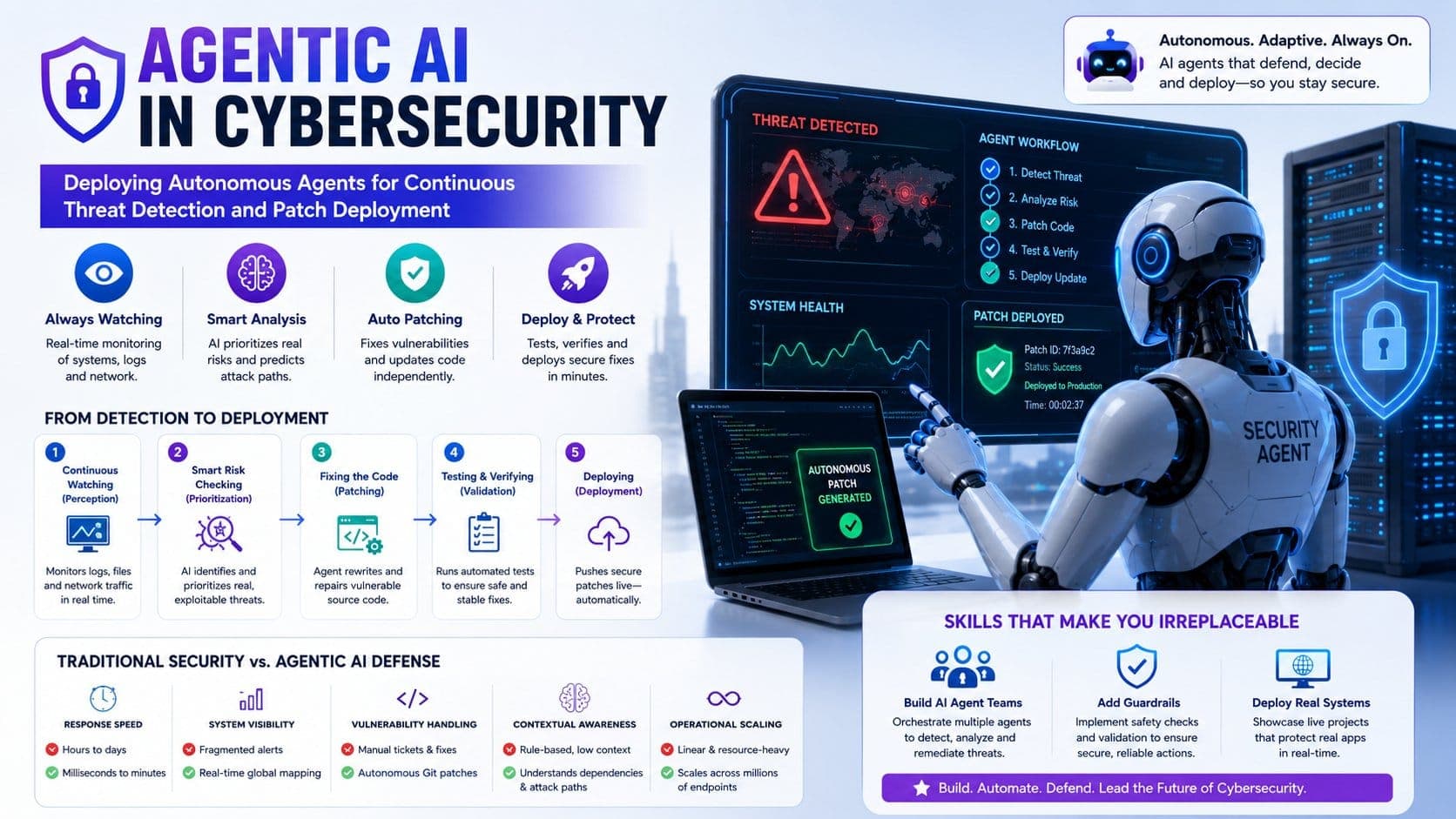
Here is a step-by-step breakdown of how Agentic AI systems protect codebases from start to finish:
| Steps | What the AI Agent Does | Why It Beats Traditional Security |
| 1. Continuous Watching (Perception) | The agent plugs directly into live systems to constantly monitor file changes, network traffic, and system logs in real time. | Traditional tools run slow, scheduled scans (like once a night). The AI agent catches suspicious activity the second it happens. |
| 2. Smart Risk Checking (Prioritization) | The agent maps out the system to see if a bug is actually reachable by hackers. If the bug is locked away safely, it ignores it; if it's exposed to the internet, it acts immediately. | Old tools treat every bug as an emergency, causing alert fatigue. AI focuses only on the threats that can actually hurt the company. |
| 3. Fixing the Code (Patching) | The agent isolates the broken software in a safe, temporary digital environment and rewrites the faulty source code to fix the security hole permanently. | Traditional tools just block network ports or sound an alarm. The agent actually plays the role of an engineer and repairs the code. |
| 4. Testing & Launching (Deployment) | The agent runs automated tests to ensure the fix works and doesn't break other features. It then packages the fix into a clean update and pushes it live. | It removes human delays. Instead of waiting weeks for a human engineer to approve and deploy a fix, the system secures itself safely in minutes. |
Here is a look at how traditional security and Agentic AI match up in the modern enterprise software environment:
| Defensive Property | Traditional SOC Operations | Agentic AI Cyber Defense |
| Response Speed | Hours to days (reliant on manual triage and human approval chains). | Milliseconds to minutes (operating at machine-to-machine speed). |
| System Visibility | Fragmented dashboard alerts and point-in-time reports. | Continuous, real-time mapping of global codebases and environments. |
| Vulnerability Handling | Manual ticket creation, code rewriting, and human deployment. | Autonomous production-grade Git patch generation and verification testing. |
| Contextual Awareness | Low. Relies heavily on external, rigid signature-based rules. | High. Understands system dependencies and real-world exploit paths. |
| Operational Scaling | Linear. Requires scaling engineering headcount to handle more servers. | Near-Zero Marginal Cost. Scales horizontally across millions of concurrent endpoints. |
Companies are no longer spending money on employees who sit all day looking at charts or monitoring basic security software. Automated platforms can do it at a much cheaper cost. What they are looking for is people who can build and manage AI tools. To remain indispensable, your GitHub portfolio must demonstrate true systems engineering.
In today’s rapidly-evolving AI era, it’s important to keep up with the latest trends. Learn how to manage smart AI tools, validate your knowledge by building real projects that employers can see and click on, and secure your place in the tech industry.