AI certifications do not really help recruiters evaluate your skills. If you have a valid AI certificate but no extensive portfolio showcasing the projects you have built while learning, you are one step behind your peers. Simple projects are no longer attractive to hiring managers; they look for complex projects that solve real-world problems. Companies are looking for engineers who can build complex RAG pipelines and autonomous AI agents that are faster and more affordable.
Here are 3 Live projects you must build alongside your Gen AI Certification to prove competence:
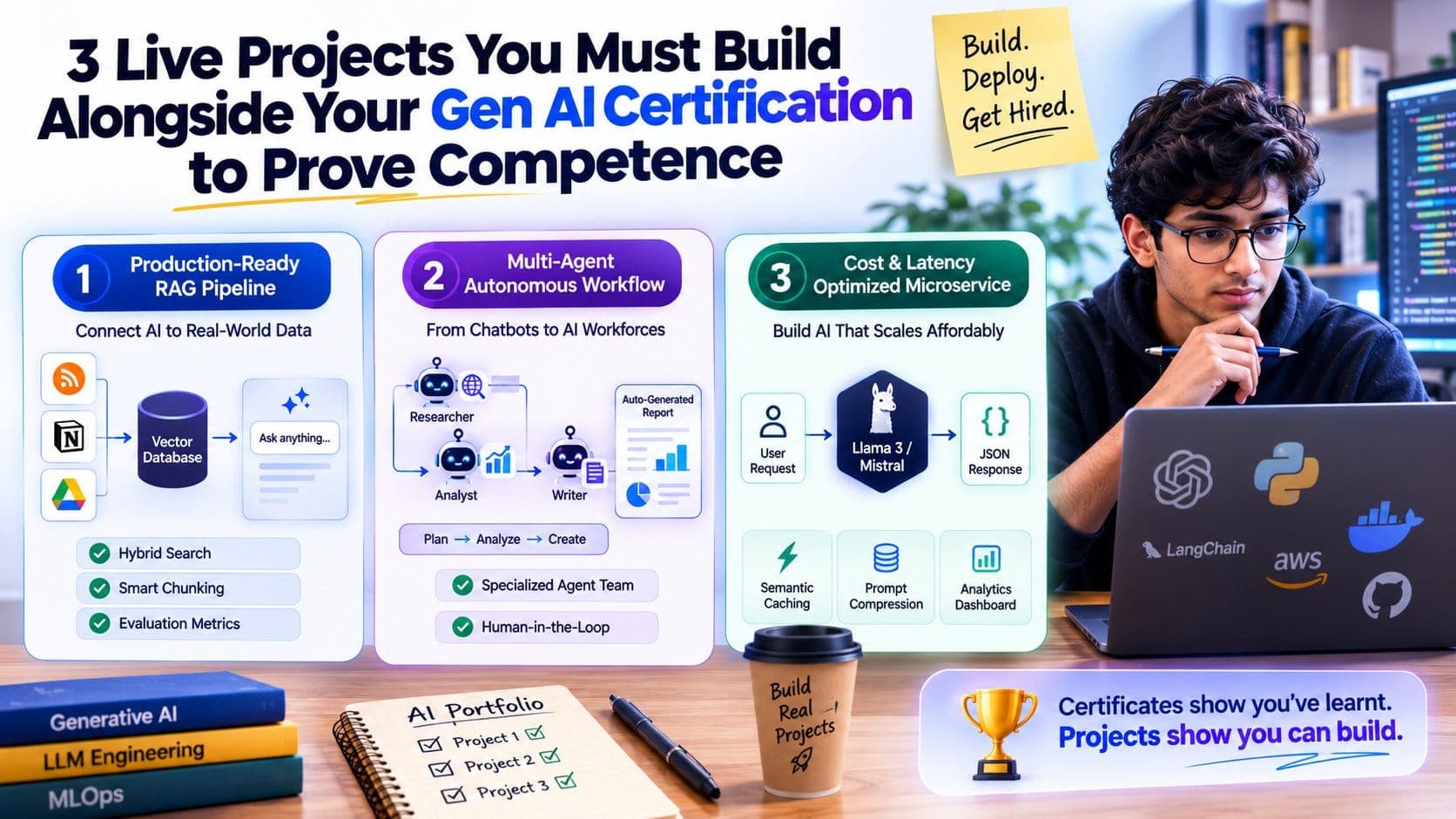
Project 1: The Production-Ready RAG Pipeline
The Goal: Connect AI to Real-World Data
If you want to retrieve something useful from an AI model, then you need to upload your dataset to the chatbot and then ask it to retrieve answers from that information, which is known as basic Retrieval-Augmented Generation (RAG). To solve real business problems, you need to go one step ahead and build a pipeline that can handle dynamic, constantly changing data from multiple sources.
The Core Architecture
- Data Sources: Set up a system that automatically pulls data from a live source, like a public RSS news feed, a Notion workspace, or a Google Drive folder.
- Vector Database: Use a professional vector database like Pinecone, Chroma, or Weaviate to store your data embeddings.
- Hybrid Search: Implement a search system that combines semantic search (understanding the meaning of words) with keyword search (finding exact words) to ensure the AI gets the most accurate information.
How to Prove Your Competence
If you want your project to stand out, then you need to show that you have not built something basic but implemented advanced RAG techniques:
- Smart Chunking: Show how you split long documents into smaller paragraphs so the AI doesn't lose context.
- Query Rewriting: Use a small LLM to take a poorly phrased user question and rewrite it into a better search query before hitting the database.
- Evaluation Framework: Use a tool like Ragas or TruLens to score your system. Add a metric on your user interface that shows the AI's "faithfulness" and "answer relevance" to prove you are actively fighting hallucinations.
Project 2: The Multi-Agent Autonomous Workflow
The Goal: Move from Chatbots to AI Workforces
Your next project should aim to develop an autonomous workflow so that you can build a system that can think, plan, use digital tools, and work together to accomplish complex tasks without human intervention. For this project, you will have to build a multi-agent system that will automate complex business operations.
The Core Architecture
- Framework: Use a dedicated multi-agent framework like LangGraph, CrewAI, or AutoGen.
- Agent Team: Create at least three distinct agents with specialized roles. For example, in a research workflow:
- Agent A (The Researcher): Scrapes specific websites and extracts raw data based on a user request.
- Agent B (The Analyst): Cleans the data, looks for trends, and highlights key insights.
- Agent C (The Writer): Takes the analyzed data and formats it into a professional Markdown report.
How to Prove Your Competence
Building a controlled and reliable AI agent that works independently is a task, so you need to add the following features to prove your efficiency:
- Human-in-the-Loop (HITL): Build a pause mechanism where the system stops and waits for a human to click "Approve" before Agent C writes the final report.
- Tool Guardrails: Show that you can handle errors. If Agent A tries to scrape a website that blocks AI, how does the agent react? Write code that forces the agent to try a backup search engine instead of crashing.
Project 3: The Cost & Latency Optimized Microservice
The Goal: Build AI That Doesn't Bankrupt the Company
Building something cool and reliable will also burn you money, but recruiters are looking for engineers who can make AI more affordable and faster so that it is feasible to run it in the long term. For your third project, build a specialized AI backend microservice (like a high-speed customer ticket classifier) using open-source models.
The Core Architecture
- Open-Source LLM: Download a smaller, powerful open-source model like Llama 3 or Mistral. Run it locally or host it using tools like Ollama or vLLM.
- FastAPI Backend: Wrap the model inside a clean, well-documented API using FastAPI.
- Structured Output: Force the LLM to return data strictly in JSON format using libraries like Pantic, making it easy for traditional software systems to read the output.
How to Prove Your Competence
This project is all about efficiency and MLOps (Machine Learning Operations). Show employers you care about the company's bottom line by adding:
- Semantic Caching: Integrate GPTCache or Redis. If a user asks a question that is 95% similar to a question asked five minutes ago, serve the cached answer instantly instead of calling the LLM again. This drops your latency to milliseconds and costs zero tokens.
- Prompt Compression: Implement a tool like LLMLingua to remove unnecessary words from prompts before sending them to the model, saving bandwidth and computing power.
- Analytics Dashboard: Build a simple frontend dashboard that tracks tokens per second, average response time, and estimated cost savings from your cache.
How to Properly Showcase Your Projects to Recruiters
After building your projects, it is important how you showcase them to the recruiters to help them understand how you have built them and how these projects are a testament to your efficiency. Hiring managers will not always download your GitHub repository, install dependencies, and run your code.
If you want to build an exceptional portfolio, then follow the three rules below:
1. Host Your Apps Live
Make your projects clickable. Use free or low-cost hosting platforms to put a working version of your app on the internet.
- Use Streamlit Community Cloud or Gradio for quick data apps.
- Use Hugging Face Spaces to host models and prototypes.
- Use Vercel or Render for your web frontends and backends.
2. Record a 60-Second Video Walkthrough
It is better for you to record a quick video explaining your project and focusing on the uniqueness of your product, so that you make your point.
- You can start by showcasing the output of your project in the first 10 seconds.
- Then you need to spend at least 30 seconds explaining the architecture diagram and the real-world problem that was solved using this product.
- Next, spend 20 seconds highlighting your "competence differentiators" (like your caching system or your evaluation metrics).
- Pin these videos to the top of your GitHub repositories and share them on LinkedIn.
3. Write an Architectural README
Replace the default GitHub README text with a professional project breakdown. Structure it like a case study:
- The Problem: What business challenge does this solve?
- The Architecture: A simple diagram showing how data flows from the user, through the models, and back.
- Engineering Decisions: Explain why you chose your stack. For example: "I chose a local Mistral model via vLLM instead of GPT-4 to reduce operational costs by 80% while maintaining a 92% classification accuracy."
An AI certificate proves that you have learnt about the theory part of AI and data science, but it does not tell recruiters what you have learnt firsthand. By building these projects, you are showcasing your best skills and putting them up front for the hiring manager to see.
 Trending
 Sakunth
 6 min read