Trending
 Sakunth
 4 min read
July 2, 2026 | 1:37 PM
Recruiters are flooded with identical resumes. To stand out, your portfolio needs production-grade AI projects, live demos, and proof that you can solve real-world business problems.
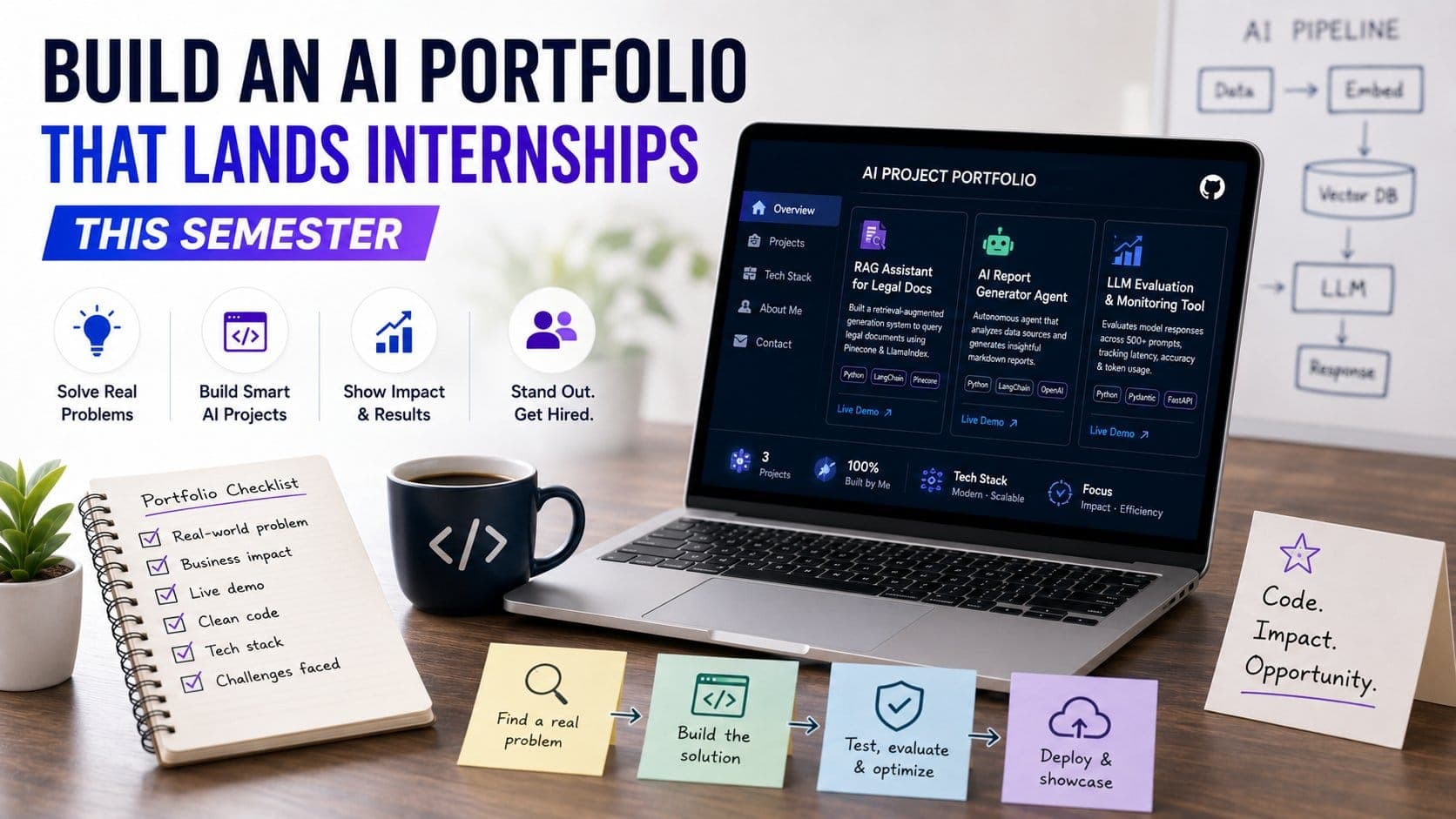
If you are a final-year student sending out resumes listing basic skills like Python or Java alongside a generic school project, you might never be able to make the cut. In 2026, recruiters and hiring managers are flooded with thousands of identical, AI-generated resumes. On paper, every single student looks exactly the same.
If you really want to grab an internship this semester, you have to prove your worth and show how you can get things done. An AI Portfolio for Internships demonstrates not only how you can use tools, but also how you can build a software that solves real-world business problems.
This guide will tell you exactly how to build an AI portfolio that actually draws recruiters to your profile!
Most students dump their half-finished college assignments onto GitHub hoping that recruiters will go through them.But unfortunately, most of the time, they don’t. Managers these days don’t care about how many codes you’ve written; they care about what that code actually achieves. They want to rest assured that you know exactly how the software works in the real world, how you can budget token costs, and how you can build systems that don’t crash under heavy use.
Now is the time to clean up your profile and focus on these four strategies:
| Strategy | The Hard Truth | Actionable Portfolio Checklist |
| 1. Kill the Tutorial Clones | Over 70% of junior portfolios rely on predictable templates (e.g., Titanic predictors, basic movie recommenders). Cloned code tells managers you can follow directions, but can't think independently. |
|
| 2. Prioritize Business Value | No one is hiring an intern to train a massive LLM from scratch. Companies hire interns to optimize workflows, fix broken data streams, and slash API token costs. |
|
| 3. Build the Big 3 Projects | Quality beats quantity. An elite portfolio doesn't need dozens of files; it needs 2 or 3 highly optimized, production-grade applications. |
|
| 4. Document for Busy Humans | An incredible codebase hidden behind a blank README.md file goes ignored. Recruiters are often non-technical, and engineers are busy; you have 30 seconds to sell your work. |
|
The PrepBytes Claude AI for Campus program, developed in association with CollegeDekho, is built exactly for this. The course provides you with the practical, hands-on skills that are needed to build solid, well-designed projects that make companies want to hire you on the spot.
Ensure that every major project you add to your profile includes a quick, easy-to-read list of the tech tools that were used. Also, mention specifically why you chose them. It should look something like this:
| Core System Layer | Chosen Framework / Tool | Purpose in Pipeline |
| Language & Backend | Python, FastAPI | Serves requests rapidly via asynchronous execution gateways. |
| Orchestration Layer | LangChain / LlamaIndex | Chains multi-step model prompts and maintains session context. |
| Vector Management | Pinecone DB / Chroma | Indexes high-dimensional mathematical data embeddings for semantic search. |
| Data Integrity | Pydantic validation schemas | Enforces rigid text structure on chaotic, unpredictable LLM outputs. |
The job market isn’t going to get better anytime soon. So, don't sit around hoping your graduation degree will get you a job. Instead, pick a real-world problem, break it down into small pieces, set strict rules for how your program should handle data, build a quick test to make sure it works properly, and upload it to GitHub. Be confident while talking about your capabilities—how you can manage cloud costs, connect data systems, and keep AI from breaking, and watch companies reach out to you.