Preparing for an entry-level AI/ML interview can be nerve-wracking, but not when you have complete knowledge about the project that you have made using your practical skills and theoretical knowledge hand in hand. You should be able to explain the project to the interviewer with clear words so that your idea is easily conveyed across the table. You should also be confident and comfortable with your skills to showcase them properly; make sure that you do not panic when you are cross-questioned.
Here is a detailed guide on how to prepare for an Entry-Level AI/ML Interview!
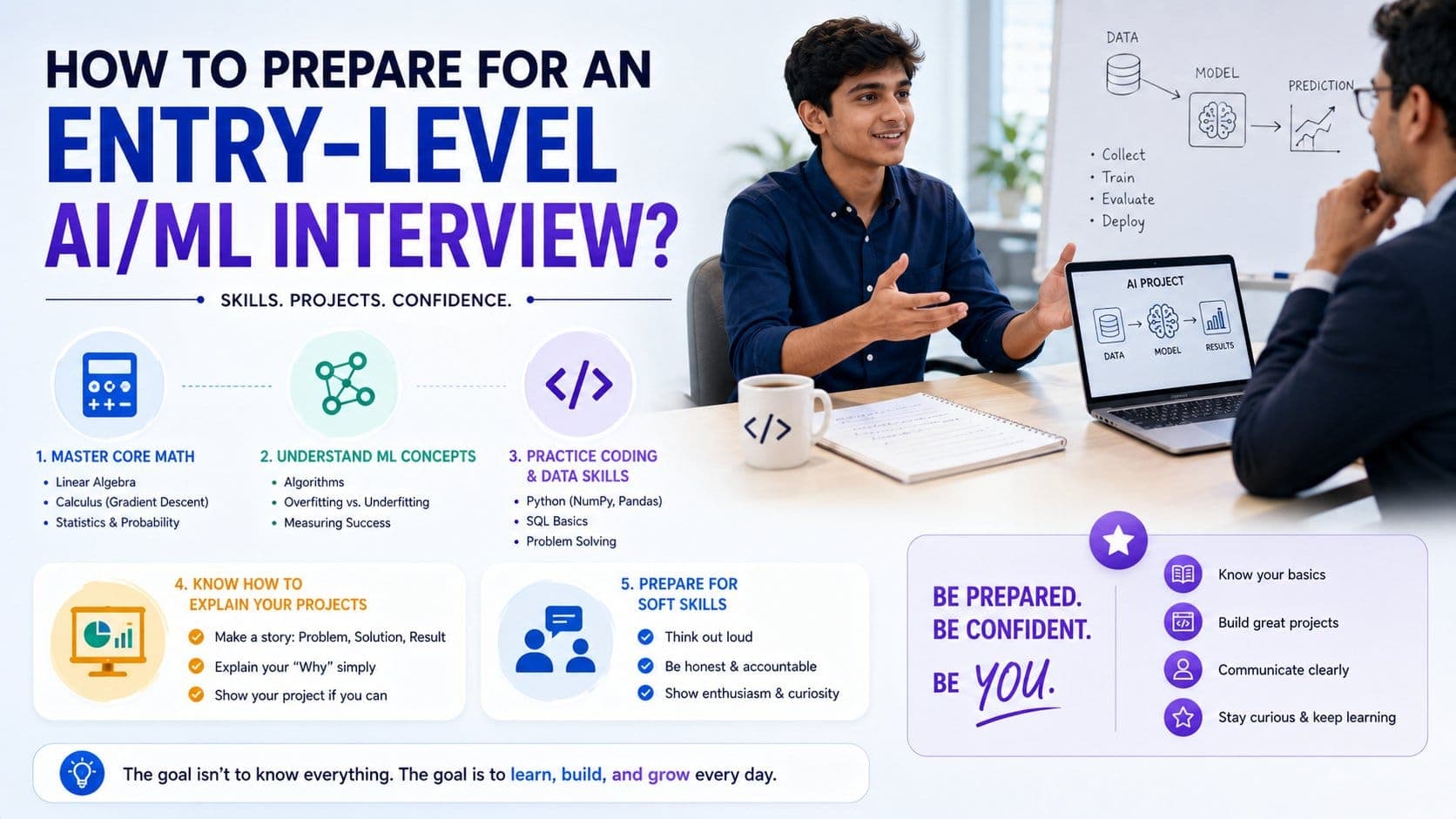
Master the Core Math Basics
To understand how an AI tool works, you do not need to have a PhD in Mathematics, but you need to understand the building blocks behind the tool.
- Linear Algebra: Understand what vectors and matrices are, and how they multiply. This is how computers store images, text, and data.
- Calculus: Focus on "Gradient Descent." This is just a fancy term for how an AI model learns from its mistakes and improves over time.
- Statistics & Probability: Know how to calculate basic probabilities and understand terms like mean, median, and standard deviation.
Understand Core Machine Learning Concepts
If you are interviewing for a junior role, then it is best that you have perfect knowledge regarding the classic models rather than learning everything at once. It is not necessary to understand the newest technology because technology is ever evolving, and you can overcome that with time.
- Algorithms: You need to first know the difference between common models like Linear Regression (predicting a number, like house prices) and Logistic Regression (predicting a category, like "spam" or "not spam").
- Overfitting vs. Underfitting: You also need to learn about overfitting and underfitting. Overfitting means the model memorized the practice data too well and fails on new data. Underfitting means the model is too simple to learn anything useful.
- Measuring Success: With AI, not everything is measured with accuracy; it is about catching every single recall rather than being right overall.
Practice Basic Coding and Data Skills
While you do not need to know every nitty-gritty detail of coding, you just need to have a decent idea of how to write clean code. Here are the topics that you need to rehearse for an entry level AI ML interview:
- Python: Basic knowledge of Python is all you need to write a decent code because this is one of the most popular languages for AI; you can practice using libraries like NumPy (for math) and Pandas (for cleaning spreadsheets of data).
- SQL: If you want to understand data, then you will have to understand databases and practice writing commands like SELECT, WHERE, and JOIN in SQL.
- Problems: Practice simple problem-solving on websites like LeetCode. Focus on basic concepts like arrays, strings, and loops.
Know How to Explain Your Projects
The one thing that you really need to prove to an interviewer is your practical skills. With every basic coding skill that you have learnt to prepare for this interview, you should try making projects that are small and tangible, which prove your professional skills more than your theoretical knowledge.
- Make a Story: When you are explaining your project, make sure to help the interviewer understand the problem that you have solved with your project, how you fixed it using the project, and what the final result of the project was.
- Explain Your "Why": An interviewer will ask why you chose a specific model or why you cleaned the data a certain way. Be ready to explain your choices simply.
- Show, Don't Just Tell: If you can show them a live link where they can click around and try your model, you will immediately stand out from other candidates.
Prepare for the "Soft Skills" and Chat Round
Companies look for people who are easy to work with and are passionate about what they do, so after preparing all the technical questions, you also need to prepare some soft skills that will help you stand out among your peers.
- Think Out Loud: If you get stuck on a coding problem during the interview, don't stay silent. Talk through your thoughts so the interviewer can see how your brain works.
- Be Honest: If you don't know the answer to a question, just say: "I don't know the exact answer to that, but based on what I do know, here is how I would try to solve it." Interviewers respect honesty much more than guessing.
Make sure that you are walking into the interview with confidence and that you know what your project and model are about so that you can explain it clearly to the interviewer. Mention that you are honest and completely accountable when explaining anything to the interviewer to leave a good impression.
 Trending
 Sakunth
 4 min read