Trending
 Sakunth
 7 min read
July 3, 2026 | 11:44 AM
Basic coding won't save your resume from layoffs. To stay competitive, you must master specialized AI Tools for Engineering Students—like terminal agents, automated debuggers, and vector databases.
Still relying on your college B.Tech degree to get you a job? It’s time to wake up to reality. With the tech industry undergoing a massive purge, companies are no longer willing to pay a hefty salary for writing basic codes or simply fixing bugs—hence, traditional engineers and developers are getting replaced by AI machines overnight.
If you want a stable career and not worry about layoffs, you need to stop using AI as a mere assistant to help you with college projects. Instead, start learning how to master the best AI tools and run them like a pro!
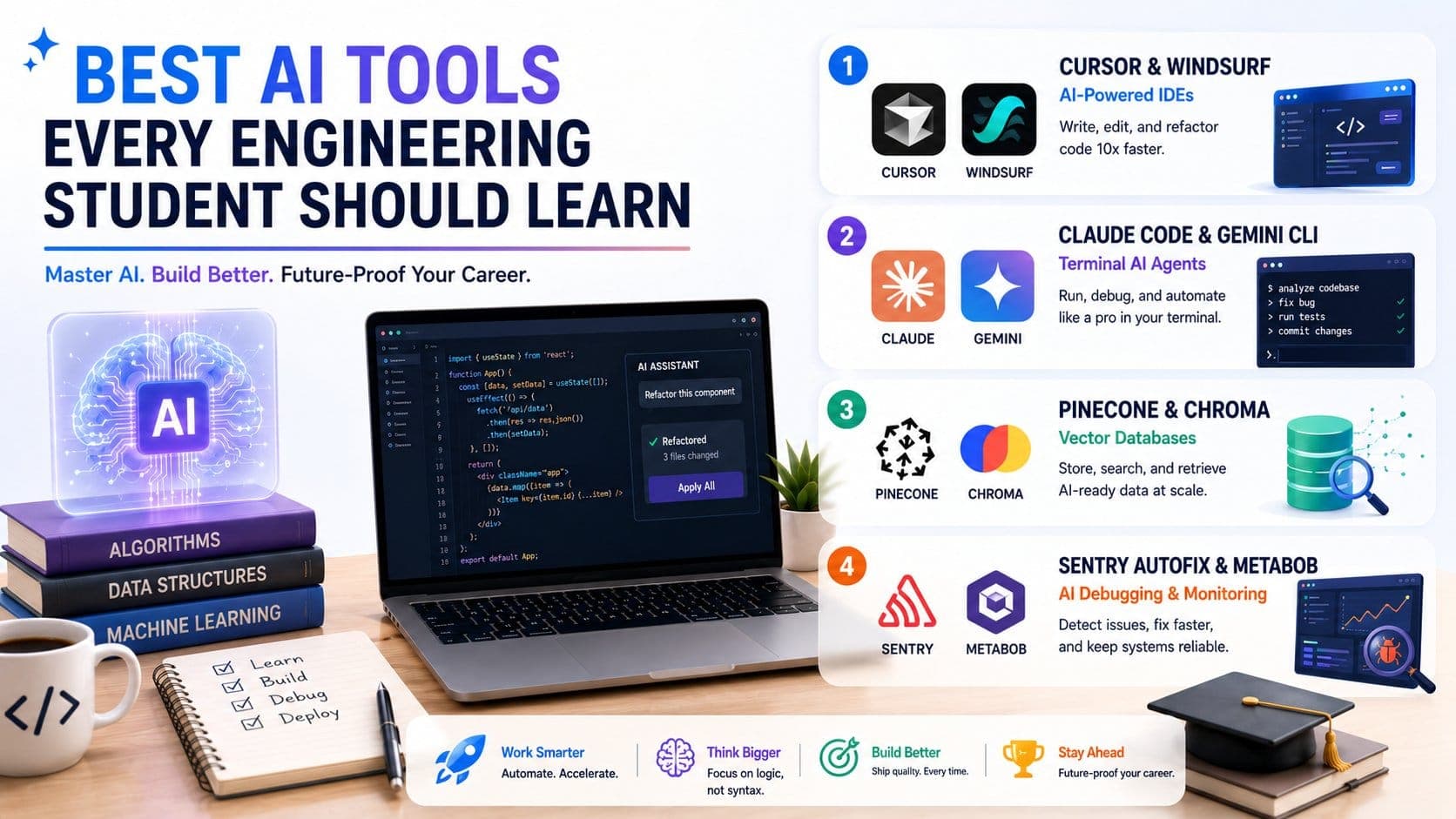
Listed below are some of the trending AI tools every engineering student must learn today to secure a high-paying role.
Stop writing codes line-by-line. The 2026 tech market is dominated by AI-driven Integrated Development Environments (IDEs). Standard extensions, such as GitHub and Copilot are fine, but platforms, like Cursor and Windsurf are ruling developer workflows.
| Feature / Aspect | The Old Way (Standard Text Editors) | The New Way (Cursor & Windsurf Workflow) | Why This Skill Makes You Valuable |
| Code Generation Scope | Autocompletes one line or a single function at a time based on what you are currently typing. | Indexes your entire local repository, allowing you to edit, create, or refactor multiple connected files simultaneously. | Companies don't build isolated functions; they build interconnected systems. You save hours of manual cross-referencing by letting the IDE understand the dependencies for you. |
| Problem Solving | You manually read a compilation error, search for the bug across files, and type out the fix line-by-line. | You highlight a block of code or an error log and instruct the IDE in natural language to rebuild the architecture. | It shifts your role from a syntax writer to a system editor. You spend your energy on logic and design rather than hunting down missing commas or typos. |
| The Core Skill to Master | Memorizing syntax rules, language libraries, and exact keyboard shortcuts. | Context Prompting: Learning how to explicitly feed specific files, folders, and system documentation into the AI. | AI is only as good as the context it receives. The engineer who knows exactly how to prompt the IDE with the right project constraints wins by shipping bug-free code ten times faster. |
The biggest shift for modern engineers is the transition from a manual coder to someone who directs automated systems. This modern way is known as “Vibe Coding”—where your logic and the ability to understand how the system works matters more than your typing speed.
Instead of navigating standard software screens or web browsers, modern developers are running smart AI assistants directly inside their command terminal using advanced tools like Claude Code and Gemini CLI.
| Feature / Capability | The Old Way (Standard Browser Chatbots) | The New Way (Terminal Agents Like Claude Code) | Why It Sets You Apart From Other Grads |
| Workflow Friction | You have to copy-paste error messages from your terminal into a web browser, wait for a response, and copy-paste it back. | The AI agent lives directly inside your command line. It reads your terminal outputs and system environment automatically. | It eliminates wasted time. While average students are juggling browser tabs, you are executing complex fixes in a single window. |
| Code Awareness | The chatbot only sees the specific snippet of code you paste into the chat box, losing the bigger picture. | The agent autonomously searches, reads, and edits multiple files across your entire local directory to fix complex bugs. | Real-world applications have thousands of connected files. Companies need engineers who can manage deep codebase modifications, not just isolated scripts. |
| Autonomous Action | The AI can only suggest code changes; you have to manually apply them, run the compiler, and test the project yourself. | The agent diagnoses a failure, writes a patch, runs your local test suite to verify the fix, and stages a Git commit on its own. | You shift from a worker doing manual labor to a project manager reviewing and approving autonomous engineering workflows. |
The PrepBytes Claude AI for Vibe Coding Course skips outdated textbook theories and dives straight into real-world developer setups, teaching you how to use advanced AI tools to build and launch professional, business-ready software much faster than your peers.
At present, every giant tech company is racing to build customized, private AI systems. Not by spending a fortune on massive AI models from scratch—but by taking an existing powerful AI model and hooking it up safely with their company’s private databases. This smart setup is known as Retrieval-Augmented Generation (RAG).
To build RAG pipelines, you must learn how to handle vector databases like Pinecone or Chroma.
| Skill Area | The Old Way (Obsolete) | The New Way (2026 Standard) | Why It's Crucial for a High-Paying Job |
| Data Retrieval | Writing basic SQL database queries to look for exact, static keyword matches. | Converting complex data (text, PDFs, images) into high-dimensional mathematical vector embeddings. | Standard databases can't help an AI understand the meaning of words. Vector databases allow the AI to search by concept and context rather than just matching exact letters. |
| System Memory | Hardcoding local session contexts, saving basic text files, or relying on short-term chatbot memory. | Utilizing Pinecone or Chroma to index massive corporate datasets for instant, secure semantic searches. | Companies cannot upload their entire secret database into a public chatbot's chat box. They need engineers who know how to store data securely on local vector servers so the AI can pull information safely. |
| Preventing Errors | Manually checking code for logic bugs or hoping the user inputs the exact right prompt. | Breaking data into smart "chunks" so the database only feeds the AI the exact, highly relevant information it needs. | If you feed an AI bad or irrelevant data, it will hallucinate and make things up. Knowing how to structure and filter data before it hits the AI keeps the system accurate and dependable. |
Typing codes is relatively easy, but debugging a massive distributed application under timed conditions is challenging. In the real world, systems don't just fail because of a missing semicolon but because of complex, hidden logic errors across multiple servers. For this, modern production systems leverage automated platforms like Sentry Autofix and Metabob.
| Tool | Core Technology | What It Detects / Fixes | Your Role as the Engineer |
| Metabob | Graph Neural Networks (GNNs) It analyzes the hidden relationships and architecture of your entire codebase rather than just reading lines of text. | Detects complex, silent logic issues—such as memory leaks, race conditions, and security vulnerabilities—long before the code is ever deployed. | Instead of guessing why a system slows down over time, you use Metabob’s architectural map to refactor faulty logic and optimize system performance. |
| Sentry Autofix | Real-Time Log Analysis & LLMs It instantly intercepts application crashes, analyzes the stack trace, and scans recent code commits for root causes. | Identifies production crashes in real time, isolates the exact broken file, and automatically writes a proposed code patch to fix it. | You no longer spend hours digging through thousands of lines of messy text logs. Your job is to review the AI’s proposed patch, ensure it's secure, and approve the deployment. |
The moral of the story—stop complaining about AI stealing jobs; master these top trending AI tools for developers and engineers today. Learn how to prompt an AI assistant, organize real-world data inside a specialized database, and write automated testing scripts to verify your systems’ functionality. Once you stop focusing on basic coding and start managing automated systems, you can stop worrying about layoffs and stand out as the most valuable resource that recruiters are desperate to hire.