Trending
 Sakunth
 5 min read
July 3, 2026 | 2:31 PM
Knowing basic syntax won't save your resume from layoffs. To stay relevant, you must master the ultimate battle of AI Tools for Engineering Students: Anthropic's Claude vs. OpenAI's ChatGPT.
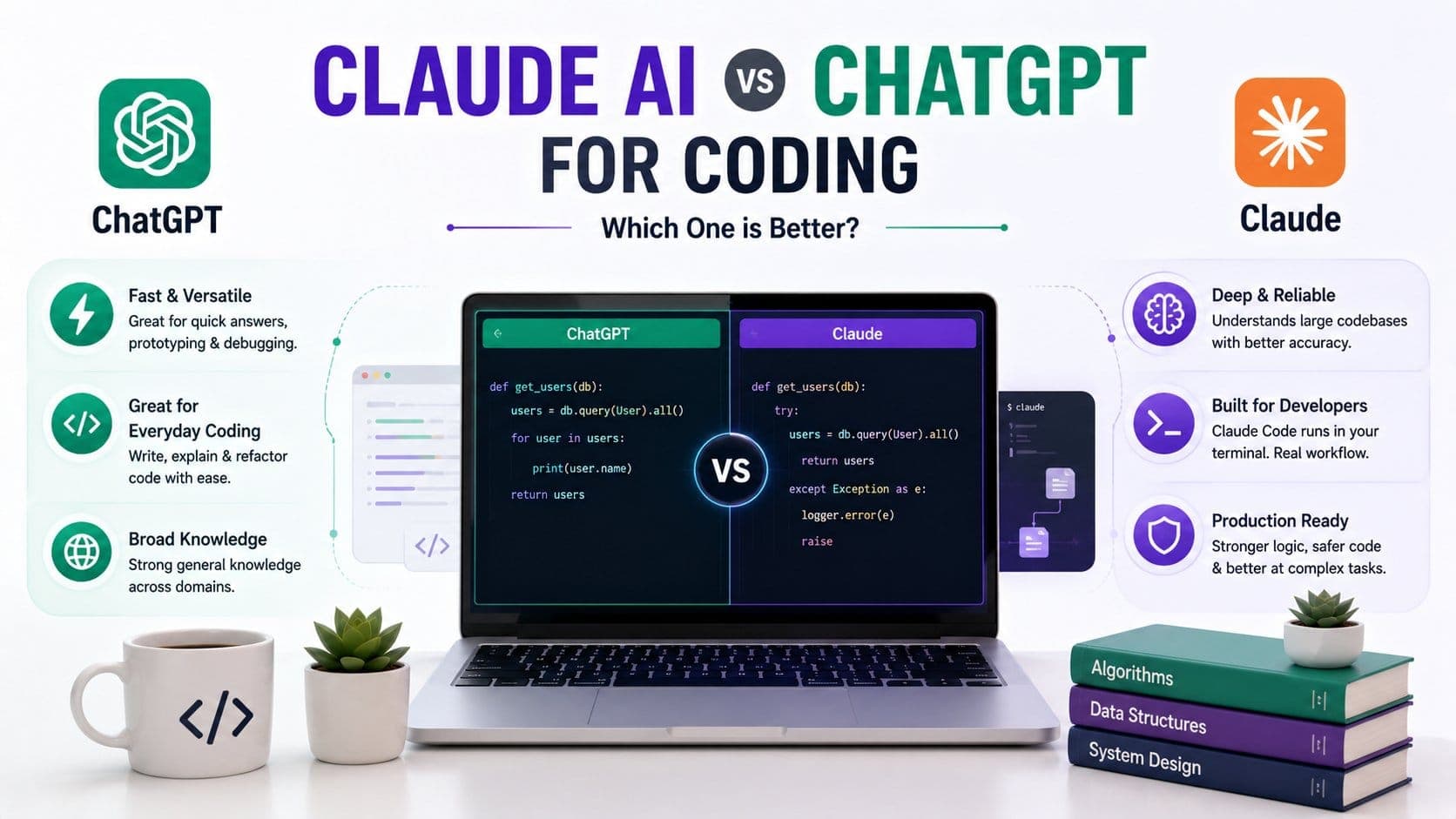
Whether you are a B.Tech student, fresh graduate, or a software engineer, knowing basic syntax won’t help you survive the current tech job market. In 2026, recruiters are not paying high salaries for writing basic code or assembling a boilerplate website. To stay relevant and employed, you need to learn and master the AI tools that professionals use to build real softwares. The two most popular and highly efficient tools that come into picture are Open AI’s ChatGPT and Anthropic’s Claude, especially for programming. But the question is—which of these two is better for coding?
Let’s skip the marketing hype and look at the honest, real-world facts about how these tools actually perform.
Working on real software for a company doesn’t just mean dealing with a single, simple code file. It involves hundreds of messy files, scripts, and links connected to one another. And that’s where the size and intelligence of an AI's memory—what tech professionals call the context window—becomes your biggest asset. It determines how many files the AI can look at and understand at the exact same time without losing track of your project.
| Metric / Feature | OpenAI ChatGPT (GPT-4o / O-Series) | Anthropic Claude (Sonnet / Opus) | Why This Difference Matters |
| Standard Context Limit | Up to 128,000 Tokens (95,000 words) | Up to 200,000 Tokens (150,000 words) | Claude can hold a significantly larger portion of your project in its brain at once, allowing it to remember complex rules you set hundreds of pages back. |
| Multi-File Architecture | Tends to fragment logic or lose track when handling more than 5 files simultaneously. | Maintains consistent naming conventions and structures across massive, interconnected directories. | Real systems require files to talk to each other. Claude acts like a senior architect who sees the whole system, while ChatGPT behaves more like an intern looking at individual pages. |
| Silent Failures (Hallucinations) | Higher tendency to guess or make up non-existent library parameters when overwhelmed. | High strictness; structurally references your provided files before executing a solution. | If an AI makes up a line of code, your entire system crashes. Claude is intentionally built to be more cautious and precise with real business data. |
The tech career for developers is shifting from manual typing to vibe coding. You are now responsible for directing an autonomous system. How ChatGPT and Claude for coding integrate into your daily workflow determines your engineering speed.
| Feature / Metric | ChatGPT (Canvas & Web Interface) | Claude (Claude Code & Terminal Agents) |
| Primary Environment | Lives primarily inside a clean web browser sandbox and cloud-based interface. | Lives directly inside your command line terminal as a native agent. |
| Workflow Friction | Requires manual uploading of files or copy-pasting code snippets to get feedback. | Operates autonomously inside your local project folders without any copy-pasting. |
| Automation Loop | Excellent for rapid prototyping, answering logic questions, and quickly generating isolated frontend templates. | Autonomously reads local files, diagnoses system bugs, writes structural patches, runs local test suites, and prepares Git commits. |
| Developer Persona | Built for the developer who prefers an interactive visual workspace and prompt-guided editing. | Built for hardcore engineers who want a terminal workforce to execute complex background tasks. |
The PrepBytes Claude AI for Vibe Coding Course is a short-term program that trains you beyond academic theory. It familiarises you with the real-world programming setups used by real companies. You will learn how to leverage Claude’s advanced reasoning to organize massive chunks of data, arrange automated system testing, and build complex apps at a speed much faster than traditional programmers.
Here is how both ChatGPT and Claude differ when building complex, company-level backends (like a secure, multi-tenant REST API):
| Engineering Challenge | OpenAI ChatGPT | Anthropic Claude | The Real-World Impact |
| Database Primary Keys | Defaults to the easiest path—using standard sequential numbers (e.g., User 1, User 2). | Automatically generates schemas using secure, random UUIDs (Universal Unique Identifiers). | Sequential keys are a major security risk; anyone can guess the next user ID. Claude builds production-ready security by default. |
| Database Performance | Frequently forgets to index foreign keys, leading to massive lag as your data grows. | Correctly structures and indexes foreign keys to ensure smooth backend data aggregations. | Missing indexes will cause a cloud database to crash or scale costs out of control under heavy user traffic. |
| Error Handling & Migrations | Focuses on writing the happy-path code, often ignoring system recovery steps. | Automatically structures clean migration scripts with proper database rollback logic. | If a database update fails mid-way, Claude’s rollback logic ensures your system resets cleanly instead of corrupting your data. |
| Functional Coding Accuracy | Scores roughly 85% on complex, multi-step functional programming tasks. | Dominates with roughly 95% functional accuracy on complex coding tasks in independent benchmarks. | Higher accuracy means you spend less time fixing the AI's mistakes and more time deploying working software. |
| Best Used For | Writing documentation, generating OpenAPI specifications, and rapid prototyping. | Core structural logic, secure database design, and complex backend architecture. | ChatGPT excels at explaining the code; Claude excels at building the heavy-duty engine. |
While both Claude and ChatGPT are highly capable AI tools, they serve very different purposes in a modern developer’s toolkit.
If you want a versatile assistant that can work with text, images and data, use ChatGPT. It is incredibly fast, highly efficient at sourcing information from the internet, preparing charts, and crafting simple scripts or marketing materials.
If you want to design a premium software that keeps you indispensable at the workplace, then master Claude. It is the best tool for deep analysis, tracking down hidden bugs, and managing huge projects with hundreds of connected files.
To survive in the 2026 tech industry, don’t restrict yourself to one tool. Use both the tools strategically—brainstorm and search the internet quickly with the help of ChatGPT, and design powerful software for scaling with Claude.