Trending
 Sakunth
 5 min read
July 16, 2026 | 6:40 PM
Find out which AI wins for competitive analysis. Use Perplexity to extract live competitor data with source links, then let ChatGPT organize it into structured SWOT frameworks and clean tables.
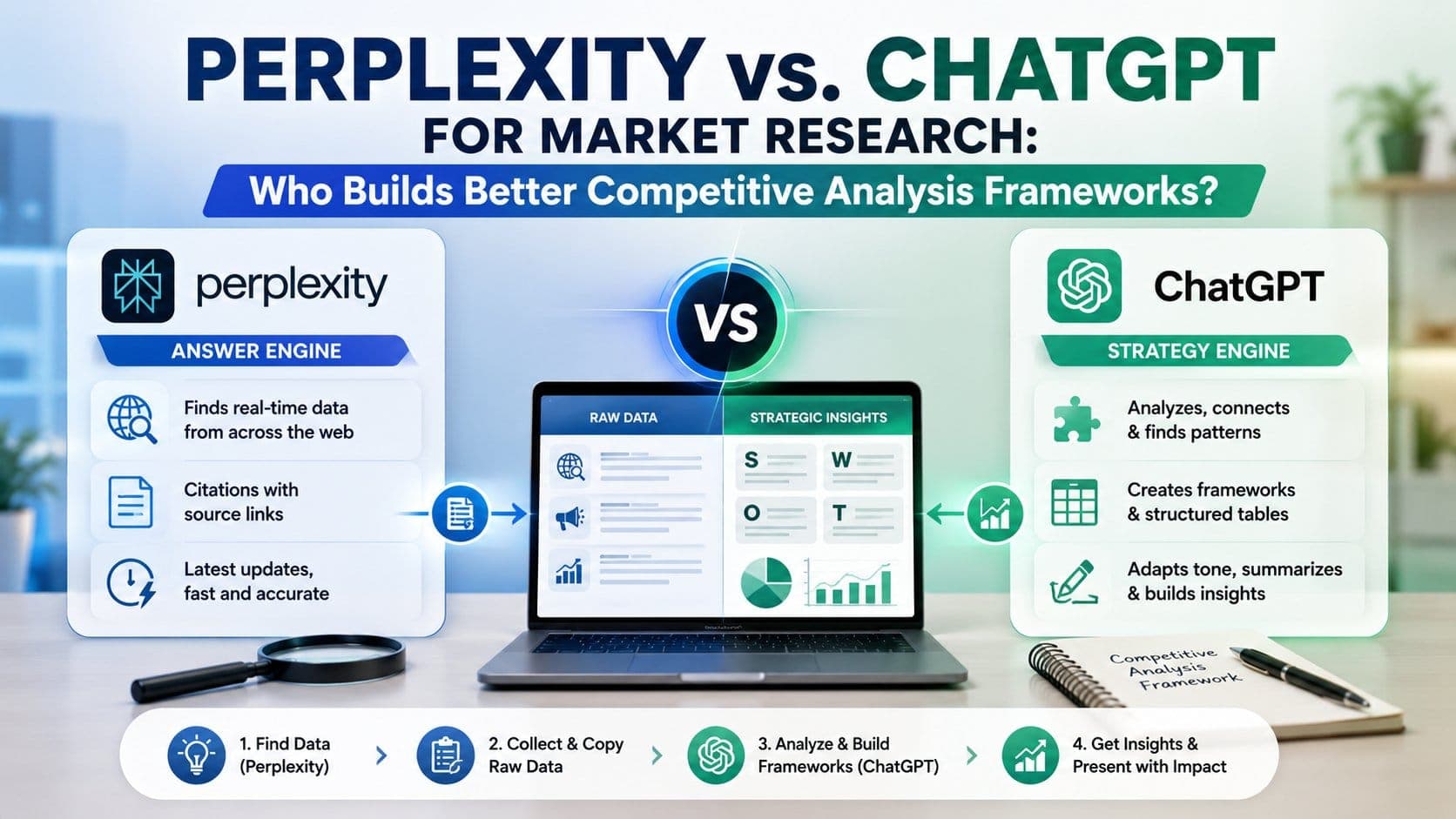
Perplexity and ChatGPT are both great tools for conducting detailed and efficient market research, but knowing when to use either of them simultaneously is a great asset. While Perplexity is a great tool for collecting raw data and competitors’ practices, ChatGPT will help you gather all the information and put it into neat tables and structured formats. To build good Competitive Analysis Frameworks, you need to know what tools yield what results and when to utilise them.
Here is a breakdown of Perplexity vs. ChatGPT for market research:
Let us first look into a simple comparison and the components of Perplexity vs ChatGPT to understand the reasoning behind each AI tool, because they are not built for the same job:
If you are looking to do a competitive analysis of your competitors, then Perplexity is the way to go because it is excellent at collecting fresh data from a competitor's website so that you get answers to questions like what your competitors are charging, what features they have just launched, and what the customers are saying about them.
If you ask Perplexity about the pricing of your competitor, then it goes out to the live web immediately, finds a recent update a competitor made to their terms of service last week, tracks down recent funding announcements on tech blogs, or pulls the latest user complaints from Reddit and review sites.
Furthermore, Perplexity gives you absolute transparency. Every claim it makes is backed by a clickable source link. This eliminates the fear of "hallucinations", which is a massive relief when you are presenting data to stakeholders or clients.
ChatGPT does have web browsing capabilities, but it tends to look at the broader internet consensus. It often misses the hyper-specific, real-time micro-data that Perplexity surfaces effortlessly.
After pulling out the data, your next step should be organising it neatly so that you can present it to stakeholders or in a presentation without making it look confusing and messy. ChatGPT is the ultimate winner when it comes to building classic business models like a SWOT Analysis (Strengths, Weaknesses, Opportunities, Threats) or a Porter's Five Forces matrix.
Building a framework requires a lot of critical thinking, which is the exact USP of ChatGPT. It will look at the raw data and spot hidden patterns, plus it can also adopt a certain tone that you want it to and then present the data in a clean, beautiful, structured table or a summary, which can be directly copied into a presentation slide.
Perplexity and ChatGPT are both equally good at the things they are made for. Perplexity is good at pulling out exact and recent data, while ChatGPT can help you make good presentations or organise the data in clean tables to be presented to a stakeholder or a senior executive.
If you want to do a complete market research, it is essential to use both the tools efficiently to build your competitive framework. To do just that, follow the steps below:
First comes the research phase, where you need to open Perplexity and ask it to find raw data to kick-start your market research. You can use a prompt like: "Search for the top 3 competitors in the [Insert Niche] space. Provide their current pricing tiers, primary target audience, and the three most common customer complaints found on forums and review sites."
After you are done finding the data, ask Perplexity to organize those findings into a simple, factual list. Copy this text along with the source URLs so you can verify the details later if needed.
Now you need to open ChatGPT and paste the raw data provided to you. Use the following prompt to organise the data as per SWOT analysis: "You are an expert market strategist. Based on the real-time competitor data pasted below, build a comprehensive SWOT analysis framework for our product."
In the last step, you need to review the output given by ChatGPT, and you can then keep the conversation going by asking follow-up questions like: "Based on this matrix, write a 3-paragraph executive summary highlighting our single greatest competitive advantage for our next board meeting."
To help you decide which tool to open first, here is a quick breakdown of how they compare across the core pillars of market research:
| Market Research Requirement | Perplexity AI | ChatGPT |
| Real-Time Data Freshness | Winner (Finds today's web updates easily) | Moderate (Better for deep research than quick searches) |
| Source Citation Transparency | Winner (Inline links to every single source) | Moderate (Provides links, but less precise) |
| Persona Adoption & Tone | Basic (Stays strictly formal and factual) | Winner (Can roleplay any business executive style) |
| Complex Logic & Synthesis | Moderate (Summarizes text perfectly) | Winner (Connects dots and finds hidden opportunities) |
| Formatting & Copy Editing | Basic (Standard lists and paragraphs) | Winner (Creates pristine tables and markdown structures) |
To conduct good market research and make a detailed presentation, you need to use Perplexity to find the facts and raw data. After getting the data, you need to then use ChatGPT to go through a complete strategic analysis plus put the data in a structured format to be presented directly in a presentation.