The Mathematics Behind Machine Learning: What You Actually Need to Know vs. What You Can Skip

user iconSakunthuser time5 min read

July 2, 2026 | 5:43 PM

Stop studying endless academic proofs. To be a top AI practitioner, focus on a code-first approach and master just enough math to reshape data pipelines, audit model scores, and prevent system crashes.
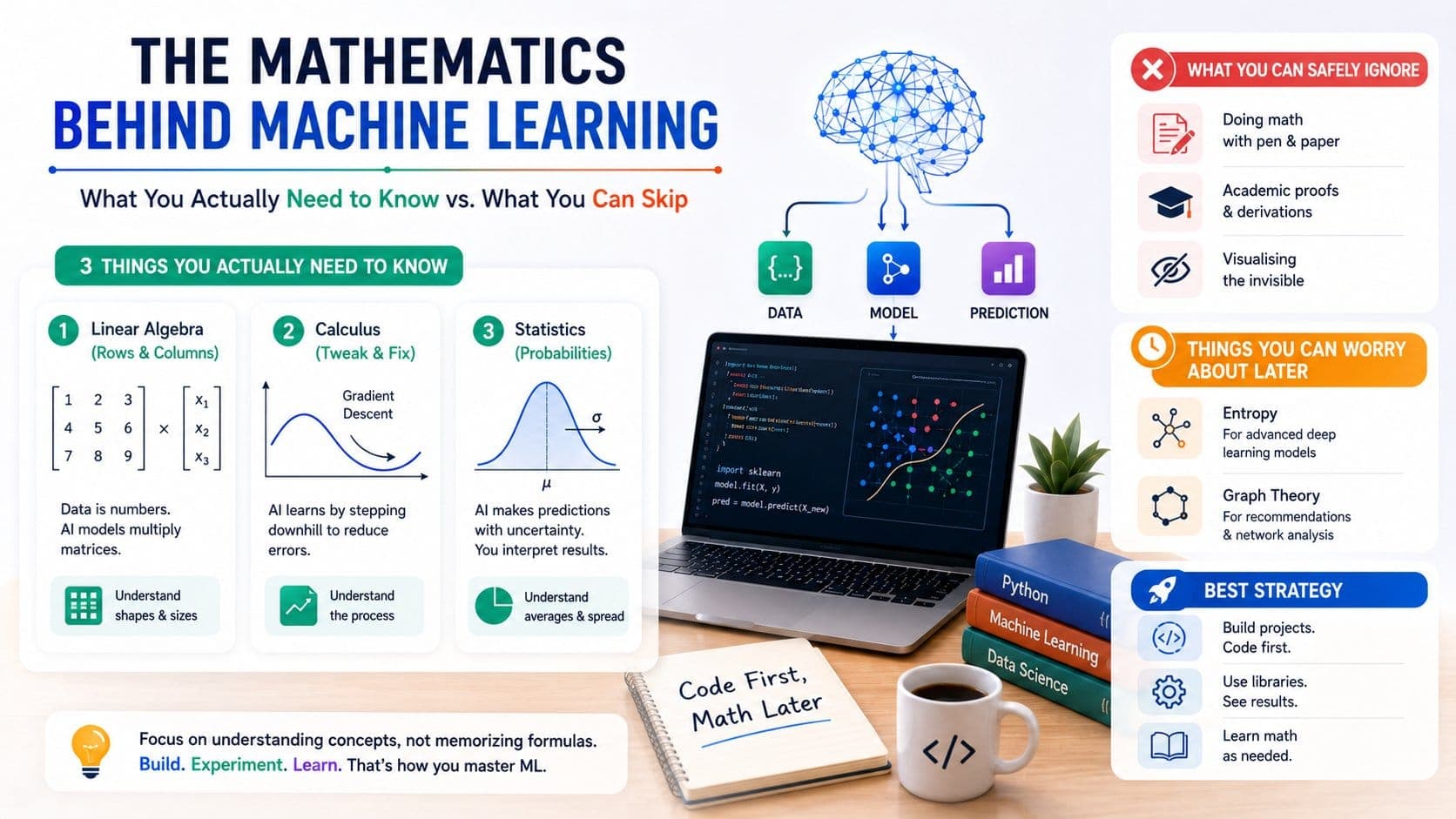
The Mathematics Behind Machine Learning: What You Actually Need to Know vs. What You Can Skip

Machine learning is the language of the future; however, it can look intimidating from afar. Mathematics is the language of machine learning; however, you do not need to be an expert in it to understand and apply ML to drive outcomes. Instead of learning about the deep mechanics of ML, you need to understand how to use it to your advantage. You do not need to be a ML researcher, which is someone who crafts new AI math from scratch. You need to be an ML Practitioner; a person using code to solve real-world problems. 

Understand the Mathematics behind Machine Learning, and learn about what you need to know and what you can completely skip. 

Do You Need to Be a Math Genius For Machine Learning?

To understand machine learning and use it efficiently to drive resolutions does not mean that you need to be a mathematical genius. Mathematics is needed to understand the complexities of machine learning; however, usually you understand the ML concepts and use the models available out there to the best of their availability. 

Software libraries like Scikit-Learn, PyTorch, and TensorFlow are built so that a single line of code handles thousands of complex math equations instantly. Your job is not to do the math by hand. Your job is to understand the concepts so you can guide the model to the right destination.

The 3 Things You Actually Need to Know

You do not need to understand all the different concepts and memorize different formulas to use machine learning, but there are three main things that you really need to know about: 

Rows and Columns of Numbers (Linear Algebra)

To help computers understand any data, the data needs to be converted into a simple list of numbers so that it can get the input to derive the particular output that you want: 

  • Concept: A single list of numbers is called a vector (like a single row in Excel). A grid of numbers is called a matrix (like a whole spreadsheet).
  • Importance: When you feed data into an AI model, the model multiplies these grids of numbers together. If your input spreadsheet has 10 columns, but your model is expecting 5, the code will crash with a "shape mismatch" error. You need just enough linear algebra to understand how to reshape your data so it fits perfectly.

The "Tweak and Fix" Process (Calculus)

To help prevent mistakes and let AI learn how they were made, Calculus is used. 

  • Concept: In math, a derivative is just a tool that tells you which way a slope is leaning. 
  • Importance: This process of stepping downhill toward the correct answer is called Gradient Descent. The best part is that you do not need to understand the mistakes yourself or have them corrected; you just need to know that AI is slowly fixing the problems by adjusting its settings. 

Dealing with Guesses and Percentages (Statistics)

Machine Learning is all about possibilities and probabilities, and it is very different from standard coding, so statistics is a huge part of it: 

  • Concept: Since AI works on probabilities and is not 100% confident in any answer, you need to understand basics like the Mean and Standard Deviation (how spread out or wacky your data is).
  • Importance: If you don't understand basic percentages and averages, you won't be able to read your model's final scorecard. Statistics helps you look at a model's output and say, "Is this AI actually smart, or was it just guessing randomly?"

What You Can Safely Ignore in Machine Learning?

Now, after the three things that you absolutely need to learn before diving into machine learning, here are some other tedious topics that you can skip over:

  • Doing Math with Pen and Paper: Because of the availability of modern AI frameworks like Autograd, you can do calculus within milliseconds without having to pull out a pen and paper and manually handle huge data. 
  • Academic Proofs: You do not need to understand why a particular mathematical formula works under a particular theoretical condition; you just need to understand how to use that formula and how to apply that formula to your advantage. 
  • Visualising the Invisible: You absolutely do not need to visualise the working of an AI model or derive the exact calculations that it is going through to help you come up with an output; you just need to trust it and make it work for you. 

Things You Can Worry About Much Later

After you transform into an experienced engineer, you may want to learn other mathematical concepts; however, these things need to be tackled at least 2 to 3 years after the initial phase of your journey as an engineer: 

  • Entropy: Entropy helps you measure how a particular dataset is designed, so when you are learning to build advanced deep learning models, you will need to understand the concepts behind Entropy. 
  • Graph Theory: This is math specifically designed to look at how things connect. Unless you are specifically building a recommendation system or analyzing social networks, you can skip this.

The Best Strategy: Code First, Math Later

The best approach to handle machine learning is to code first and then learn the math much later when you are at an advanced level: 

  • Always try to do a practical test rather than reading books and books on machine learning and then getting bored. Find a simple tutorial that helps you to build something tangible and use it to build a portfolio. 
  • Use tools that support your coding. Run the code using libraries like Scikit-Learn. See how the data goes in and how the prediction comes out.
  • If the tutorial comes with jargon that you do not understand, then stop and look for a quick article explaining that, and then go on with your tutorial. 

When learning AI and ML, it is important to start, then anticipate and read tutorials. There are 1000 books published on machine learning, but the most you will learn is through making tangible products via tutorials available on the internet. You do not need to learn everything in one go, and there are some things that you can completely ignore too. 

BEGINNER30 DAYS6 HRS / WEEK

AI for Campus

AI for Campus — Your AI Edge in College & Beyond. Powered by Claude by Anthropic · 30 Days · All Streams Welcome. A first-of-its-kind AI literacy programme for students entering graduation and post-graduation. This is not a theoretical course — every session puts Claude...

BEGINNER TO INTERMEDIATE3 MONTHS2 HRS / WEEK₹1,501 OFF

Claude AI for Shopify

This bootcamp is for D2C founders, e-commerce entrepreneurs, and students targeting retail tech careers. Build and grow a Shopify store end-to-end using Claude as your content engine, ops assistant, and analytics co-pilot. Go beyond basic tutorials — integrate AI into r...

₹5,500₹3,999
Enroll Now →
BEGINNER TO INTERMEDIATE3 MONTHS2 HRS / WEEK₹1,501 OFF

Claude AI for Business Analytics

This bootcamp trains analysts, finance pros, ops managers, and consultants to turn data into decisions using Claude as an AI co-pilot. Participants learn to clean data, write SQL, build dashboards, interpret KPIs, and deliver executive insights — no data science degree ...

₹5,500₹3,999
Enroll Now →
BEGINNER TO INTERMEDIATE3 MONTHS2 HRS / WEEK₹1,501 OFF

Claude AI for Content Creators

This bootcamp is built for content creators, copywriters, social media leads, and aspiring writers who want to use AI as a creative co-pilot — not a ghostwriter. In a world where content is the currency of influence, this programme ensures you produce more, faster, with...

₹5,500₹3,999
Enroll Now →
BEGINNER TO INTERMEDIATE3 MONTHS2 HRS / WEEK₹1,501 OFF

Claude AI for Digital Marketing

This bootcamp is built for aspiring marketers, growth hackers, and performance specialists. In a world where content velocity wins, this programme ensures you enter the industry with a real competitive advantage — the ability to plan, create, and optimise full marketing...

₹5,500₹3,999
Enroll Now →
BEGINNER TO INTERMEDIATE3 MONTHS2 HRS / WEEK₹1,501 OFF

Claude AI for Vibe Coding

This bootcamp is built for non-coders, first-time builders, and anyone who has ever had an idea for a product but couldn't code it. Using natural language and Claude's AI capabilities, you will ship real apps, websites, and automations — without memorising syntax or sit...

₹5,500₹3,999
Enroll Now →